From the land and the forge to the birds of America
Four hundred and twenty-six ancestors from a single family in the
pays d'Ancenis (the area around the town of Ancenis), traced from 1527 to
the present day. Almost all of them were laboureurs (well-off tenant
farmers who owned their own plough team — the top of the village social
hierarchy), almost all born between the Erdre and Loire rivers. And, on a side
branch, a laboureur's daughter from Les Touches who sailed for Saint-Domingue in
the early 1780s, and whose son would become the world's most famous painter of
birds.
426direct ancestors
16generations
11main communes
1527earliest ancestor
I · The land
A handkerchief of land
Of the 426 ancestors, the overwhelming majority were born in a
handful of paroisses (parishes — the basic civil and religious
administrative unit before the Revolution) in the north of Loire-Inférieure
(the department's name before its 1957 renaming to Loire-Atlantique), between the
Erdre and Loire rivers. Mésanger and Les Touches alone account for ninety-three of
them.
Schematic map. The size of each dot is proportional to the number of
ancestors born in that commune. Nantes and Ancenis are shown as landmarks;
Couëron, in red, will reappear later.
This concentration is not incidental. It tells the story of a society where
one married one's neighbour, where the land was never left, and where the same
surnames return generation after generation. The parish records bear direct
witness to it: Pierre Ouary and Anne Ouarie, married around 1730, were cousins.
The whole line of descent therefore traces back twice to the same
sixteenth-century ancestor, by two distinct paths.
Two exceptions break this circle. The Vavasseur, blacksmiths, came from the
borderlands of Morbihan and Côtes-d'Armor, a hundred and fifty kilometres away.
And one branch left for America — the subject of Part Six.
What people lived on
Laboureur22
Farmer (f.)8
Farmer (m.)4
Blacksmith3
Baker2
Innkeeper2
Mason2
Sharecropper1
Carpenter1
Housewife1
Occupations recorded for direct ancestors only. A
laboureur was not a day labourer: he was the peasant who owned his own
plough team and ploughs — the top of the village hierarchy.
A peasant ancestor generally leaves only three lines: a baptism, a
marriage, a burial. Three men in this line are the exception, because an event threw
them into the archives — a civil war, an industry, a photograph.
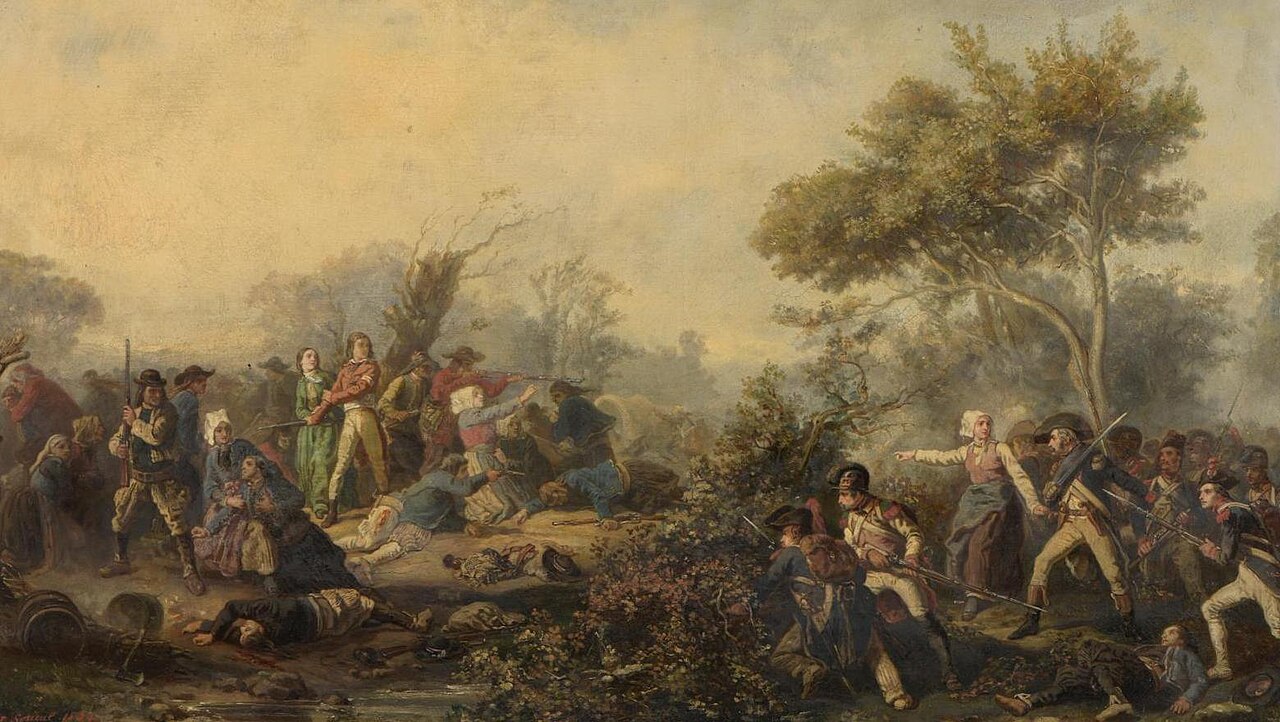
A column of Chouans in ambush. No portrait of Jacques Guérin exists: nineteenth-century painting remembered the other side instead. Jean Sorieul, 19th century, public domain · Wikimedia Commons
7th generation
Jacques Guérin
c. 1747 — 7 June 1794
baker, innkeeper, municipal officer
He kept a bakery and the inn of L'Écu de France in Riaillé, and served
the commune as municipal officer. On the night of 6 to 7 June 1794 — 19 Prairial
Year II in the French Republican calendar — the chouans (royalist
insurgents of the Chouannerie, the counter-revolutionary uprising in western
France) from the Segré area, led by Sarrazin, raided Loire-Inférieure: they sacked
the forges and massacred some thirty republicans. Jacques Guérin was killed in the
back room of his bakery, at the top of the town.
The register records him as the widower of Jacquette Letort, aged
forty-seven. His brother-in-law Jacques Letort, mayor of Saint-Mars-la-Jaille, had
been shot by the chouans six months earlier. The site of his death later became
the Café Delanoue — named after his own descendants.
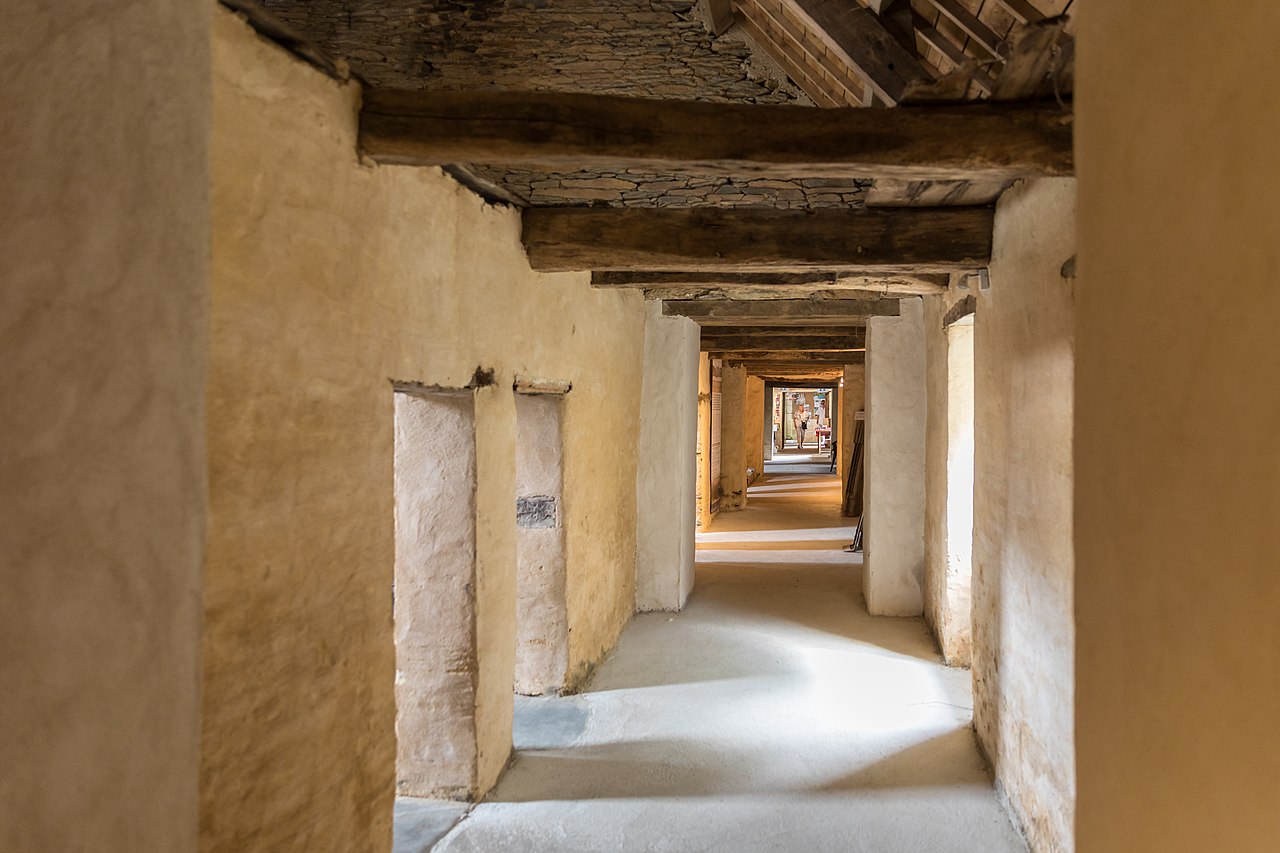
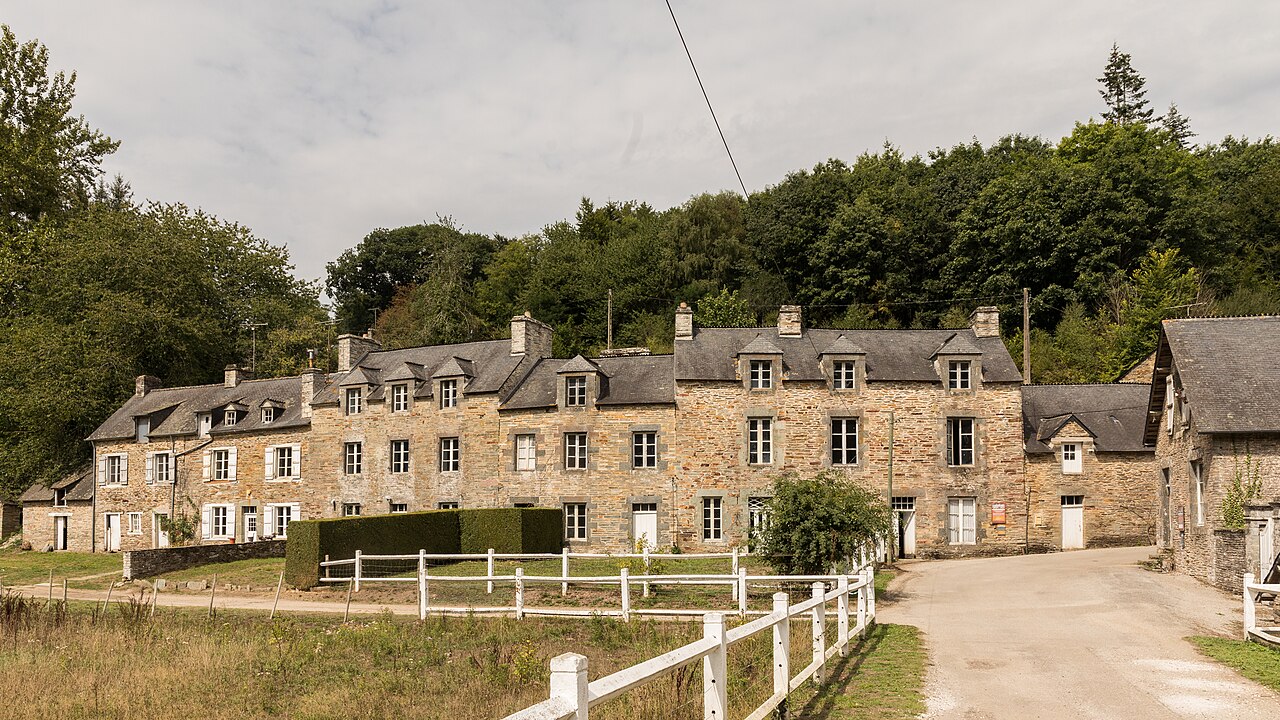
Les Forges des Salles, in the Quénécan forest. Manor house, workers' terraces, charcoal halls: the village has not changed since 1877. Wikimedia Commons, CC BY-SA · Wikimedia Commons
9th generation
François Vavasseur
1699 — 1762
blacksmith at Forges des Salles
The only non-peasant branch in the whole ancestry. He married Marie Le Breton
at Forges des Salles on 9 February 1728 and had twelve children with her, all
born in this village lost deep in the Quénécan forest. At least five would not
reach adulthood.
He died there in 1762, aged sixty-three. His father Olivier had already been a
blacksmith, his son-in-law Jacques Chauvel was a hammerman: three iron trades
under the same roof. The rest of this story fills the next section.
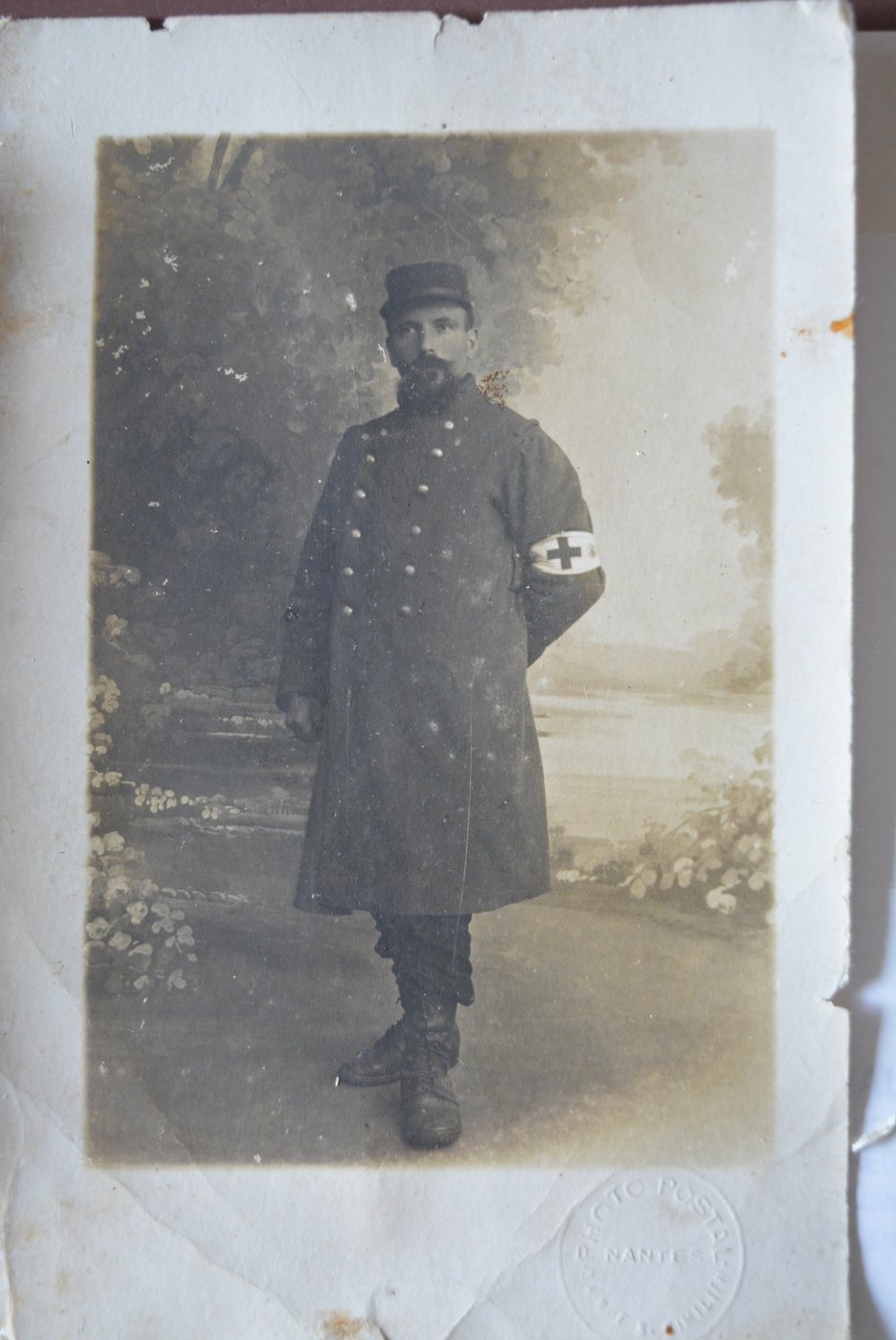
Louis Frédéric Bonnet in uniform, armband on his sleeve, during the Great War. Family collection
3rd generation
Louis Frédéric Bonnet
1884 — 1957
stretcher-bearer, farmhand, farmer
A stretcher-bearer during the Great War. His brother Henri was killed there in
1915, aged twenty-nine, in the attack at Quennevières. A photograph shows him in
uniform, armband on his sleeve.
Before farming a very small holding at Carquefou, he was employed — a
"valet," as the family called it — by the Marquis de Dion, probably at the
Château de Maubreuil. The same man who founded the De Dion-Bouton works, for a
time the world's leading car manufacturer. The gap between the two destinies,
within the same field of view, says a good deal about what rural society was
like in 1910.
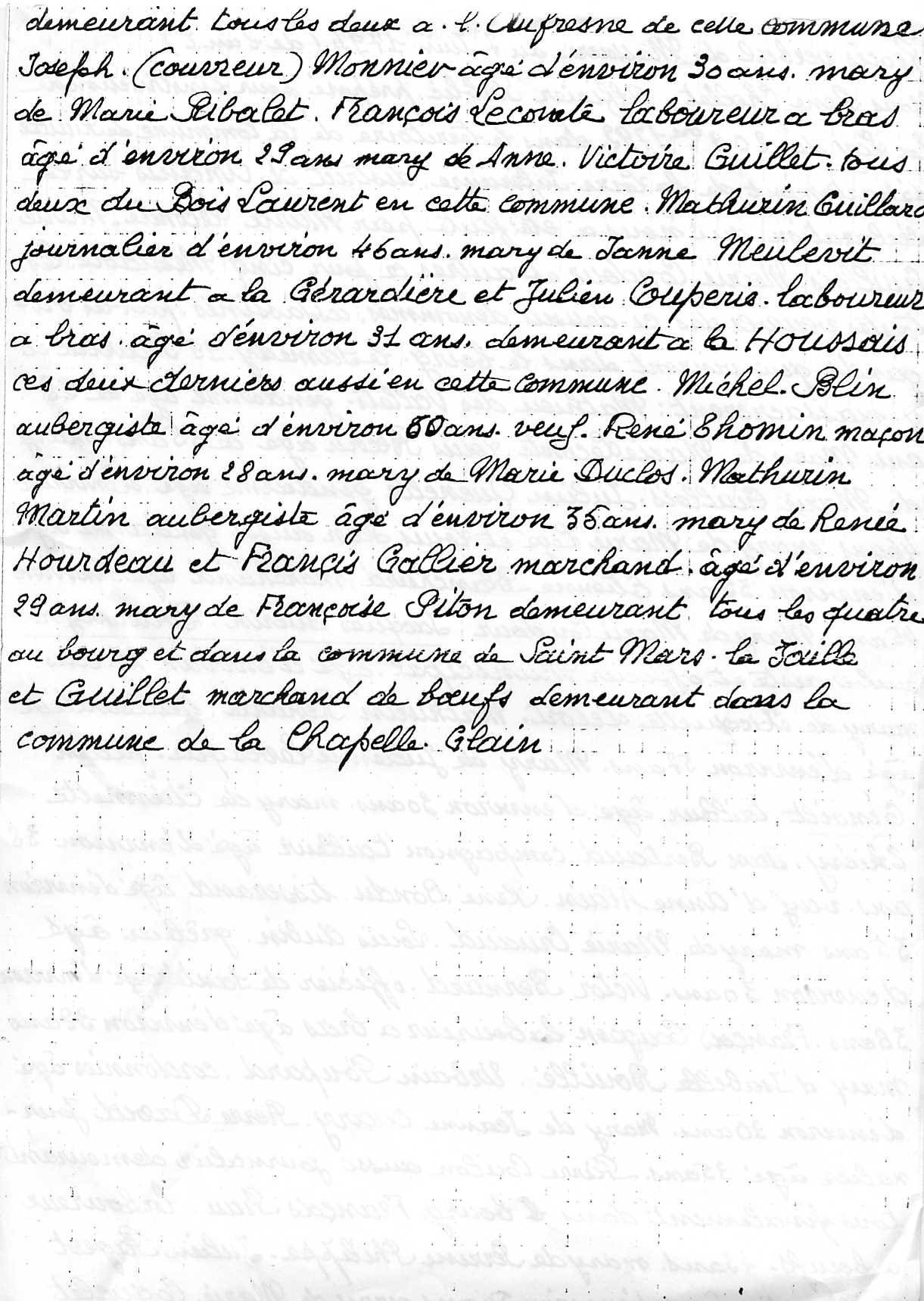
We, René Chollet, public officer appointed for the execution of the law of
20 September 1792 in the territory of the commune of Riaillé, department of
Loire-Inférieure, district of Ancenis, upon the declaration made to us by the
widows of those named below, murdered by the Brigands who came to the town on
Saturday 29 Prairial and there slaughtered:
Civil register of Riaillé, 19 Prairial Year II
Mathieu Desvallets28gendarme · husband of Marie Leconte
Louis Bechu35gendarme · husband of Marie Guillois
Julien Quenelle46gendarme · husband of Marie Guais
Louis Jean35gendarme
Étienne Blanchard45merchant · husband of Marie Coudoux
Jacques Guérin47baker, innkeeper and municipal officer · widower of Jacquette Letort
There are six of them. The massacre claimed about thirty. The discrepancy is
not a contradiction: the public officer only recorded the deaths of those whose
widows came forward to make a declaration. The unmarried, the
widowers, those whose family never came forward, appear nowhere. Jacques Guérin
is there because he was a widower himself, and his descendants had his death
recorded in the civil register.
There follows a long list of residents who came to testify, each with his
age, occupation and wife's name: laboureurs à bras (labourers who worked
the land by hand, without a plough team — poorer than the ordinary laboureur), a
day labourer, a mason, a cattle merchant, and two innkeepers from the town of
Saint-Mars-la-Jaille — the same trade as the dead man.
One last copying detail. The register reads "Saturday 29 Prairial," but
29 Prairial Year II fell on a Tuesday. The 19th, however, was indeed a Saturday:
the copyist mistook one digit for another.
The rest of the official report: the witnesses summoned, with their age, occupation and wife's name. Family collection
III · The road of iron
Two hundred and forty-eight kilometres, six generations
Breton ironworkers were not settled folk. A charcoal-fired
ironworks devours its forest: when the charcoal runs short, the blast furnace is
banked while the coppice regrows, and the families move on to the next site. The
Vavasseur, and then the Chauvel they married into, followed the iron this way for
two centuries — from the forest of Paimpont to the bocage (the hedgerow
farmland landscape typical of western France) of Riaillé.
Schematic map. The dates correspond to the family event attested at
each site.
The route is anything but aimless wandering. Each of these stops is a major
ironworking site, and all belong to the same world: that of the charcoal-fired
ironworks of inland Brittany, where the ore surfaces and the forest supplies the
fuel. Paimpont and its eight thousand hectares, la Hardouinais mentioned as
early as 1570, Quénécan and its three thousand six hundred hectares.
What is striking about these trajectories is that they were the rule.
Genealogists of the region have long since identified these families
circulating between the Paimpont, la Hardouinais, Loudéac and Quénécan forest
massifs, crossing the boundaries of Ille-et-Vilaine, Côtes-d'Armor and Morbihan
before moving down into Loire-Atlantique — Héric, Orvault, Sautron and,
precisely, Sion-les-Mines. The Vavasseur are a textbook case.
The trade itself broke down further: fondeur (furnace smelter),
affineur (iron refiner), marteleur (hammerman),
chauffeur (furnace stoker), valet de bordeur (an edger's
assistant). Jacques Chauvel, who married Anne Vavasseur, was a marteleur — the
one who beat the iron bloom under the hydraulic trip hammer. Forge families
married among themselves, and the position passed down along with the name.
The last stop closes the loop in a way that chance only half explains. In
1875, the Riaillé forges shut down for good. A family note, taken from a
website devoted to the history of the bocage's ironworks, records that their
last director was named Chauvel. Olivier Chauvel, a blacksmith turned innkeeper
and tavern-keeper, great-grandson of François Vavasseur, died at Riaillé on
14 March of that same year, 1875.
The file does not establish that this director was him: his declared
occupation remains "blacksmith, innkeeper." But the coincidence of place, name
and year is worth noting, and would deserve checking against the archives.
Riaillé is also the commune where, eighty years earlier, the chouans had
sacked the forges and killed Jacques Guérin. Two branches of the same
ancestry, one coming from the bocage and the other from the forests of central
Brittany, meet in the same industrial village.
Riaillé did not in fact have a single forge but three sites staggered along
the same waterway: the blast furnace at la Poitevinière, the finery forge
downstream at la Provostière, a slitting mill at the far end at la Vallée. The
two ponds, seventy-five and seventy-three hectares, were the largest in the
region. They cast nails, cauldrons, fireplace backs and cannonballs there.
The blast furnace at la Poitevinière still stands: eight metres high by
nine on a side, built of schist, with a circular hearth. Listed as a historic
monument (Monument historique) on 1 April 1986, it is the last
survivor of the Pays de la Mée's metallurgical adventure. The place's name
comes from the families brought from Poitou to work the ore — another
migration of iron, four centuries before that of the Vavasseur.
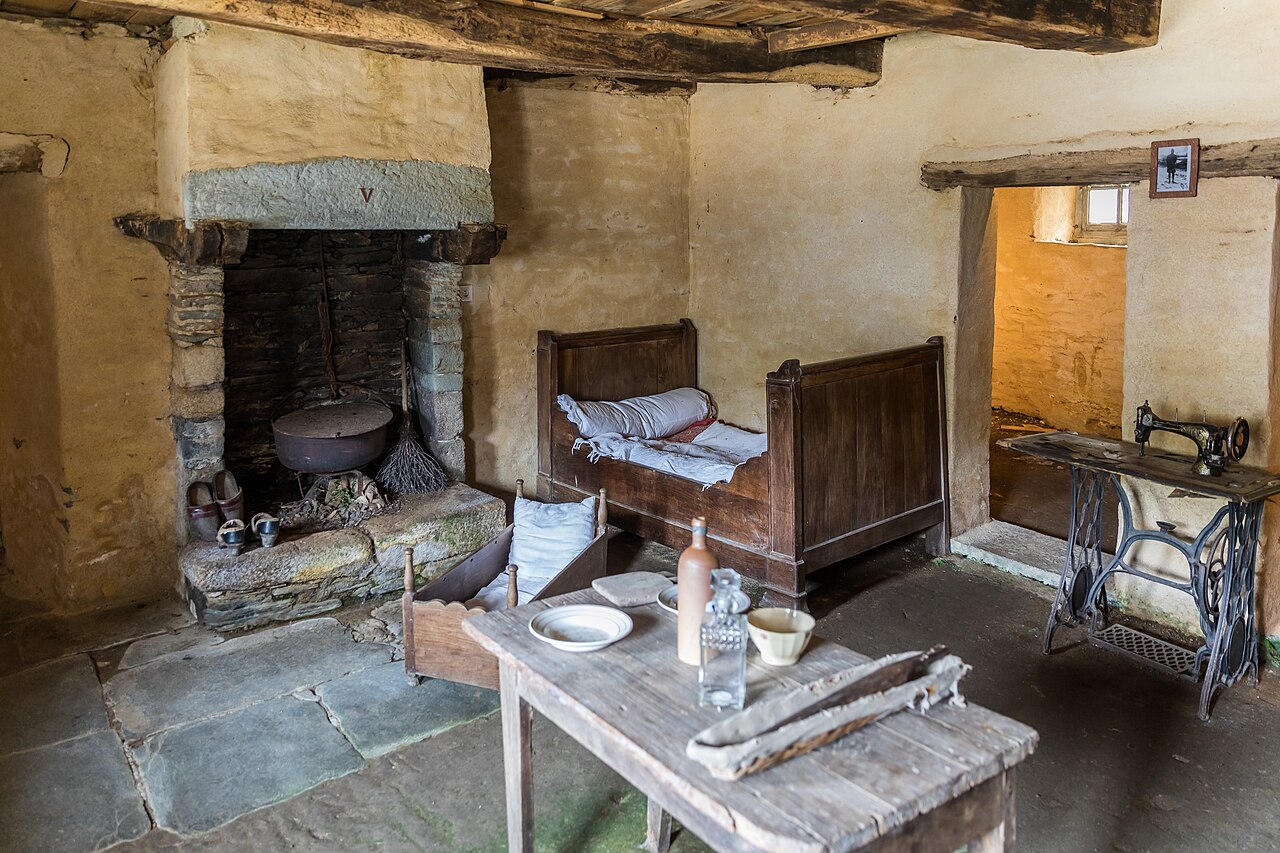
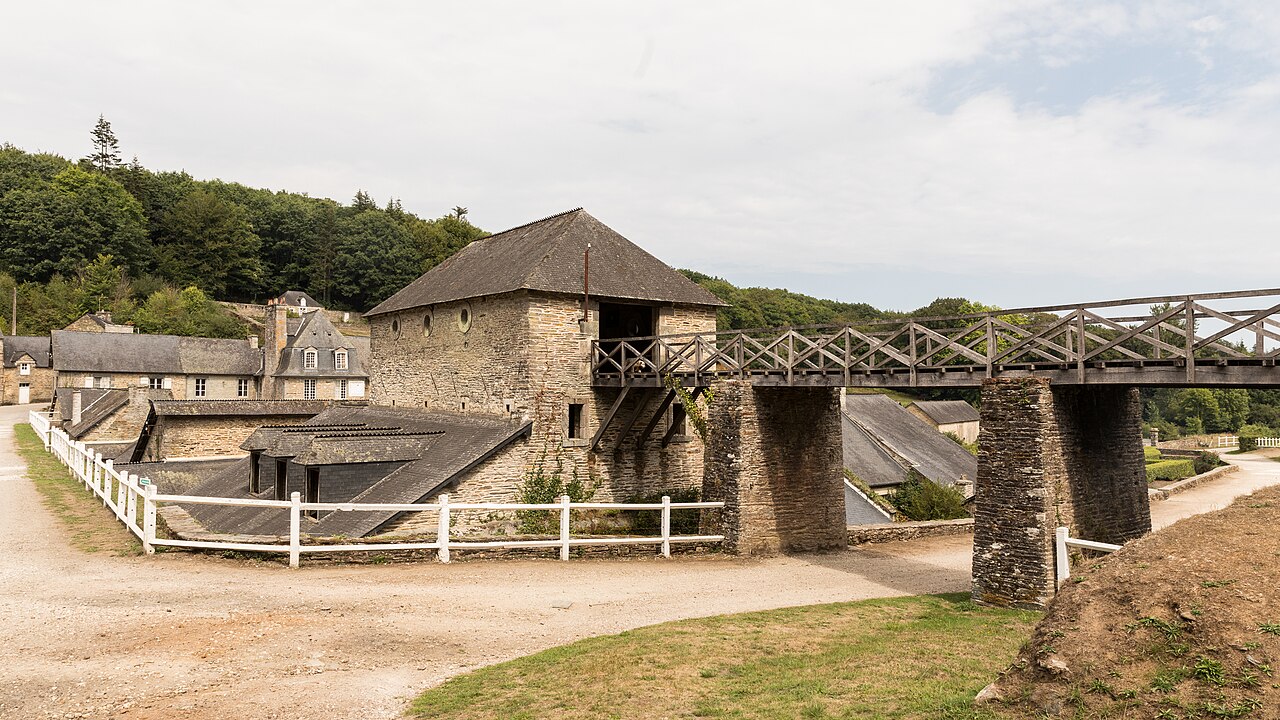
The village has not changed since the blast furnace stopped, on 1 July 1877. Wikimedia Commons · Wikimedia CommonsFounded in 1623 by the Rohan family, the site produced iron for two hundred and fifty years. Wikimedia Commons · Wikimedia CommonsThe ironmaster's manor house, workers' terraces, canteen, school, chapel, terraced gardens: listed as a historic monument in 1980, the whole site can be visited. Wikimedia Commons · Wikimedia Commons
At journey's end: la Poitevinière
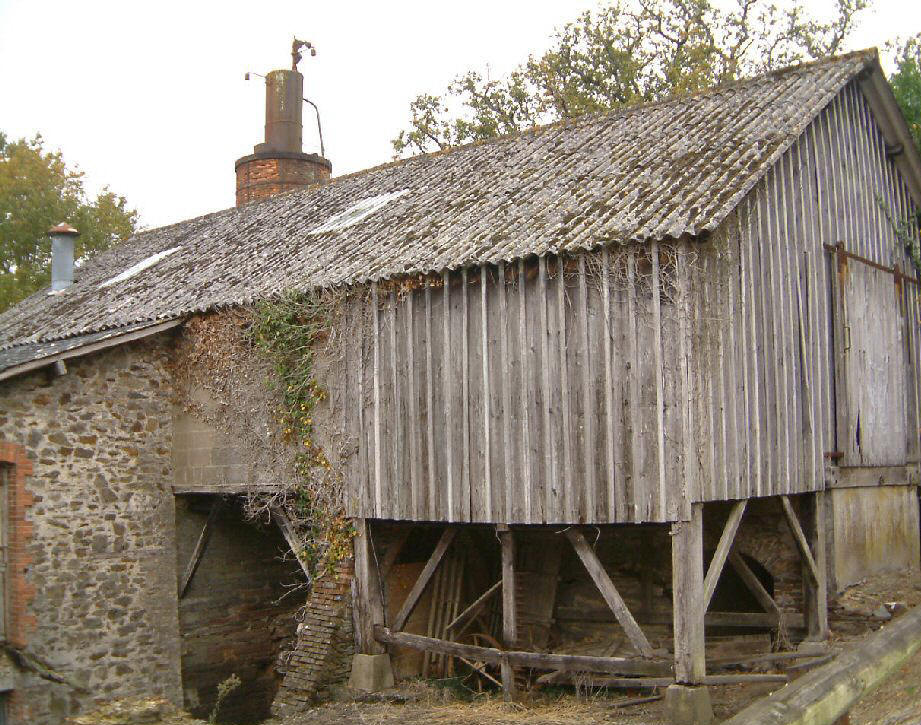
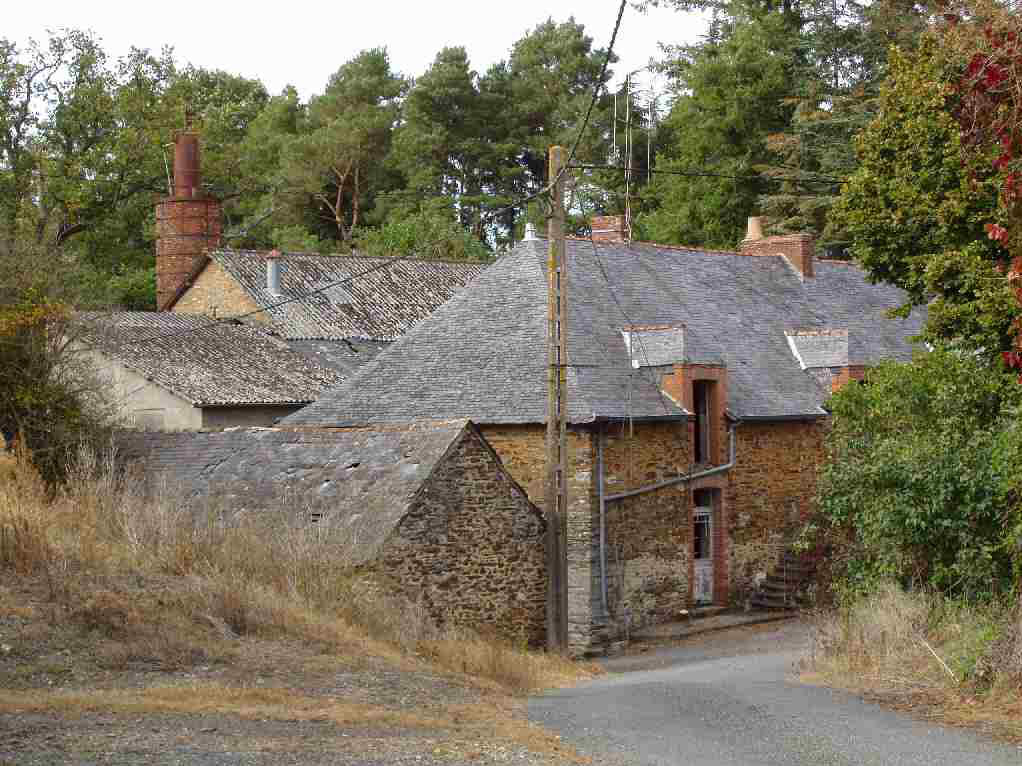
The hamlet of la Poitevinière, at Riaillé, where this two-century migration
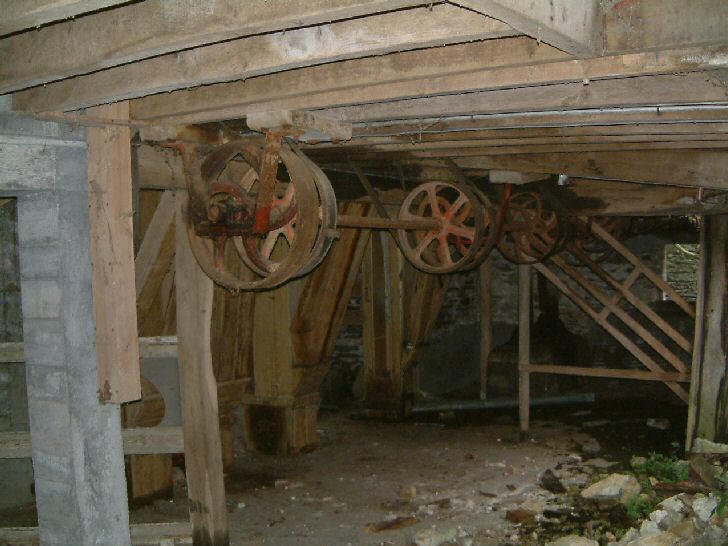
comes to an end. The same pond powered both the forge's bellows and the mill's
grindstones: when the blast furnace went cold, the flour mill kept turning at
the foot of its chimney.
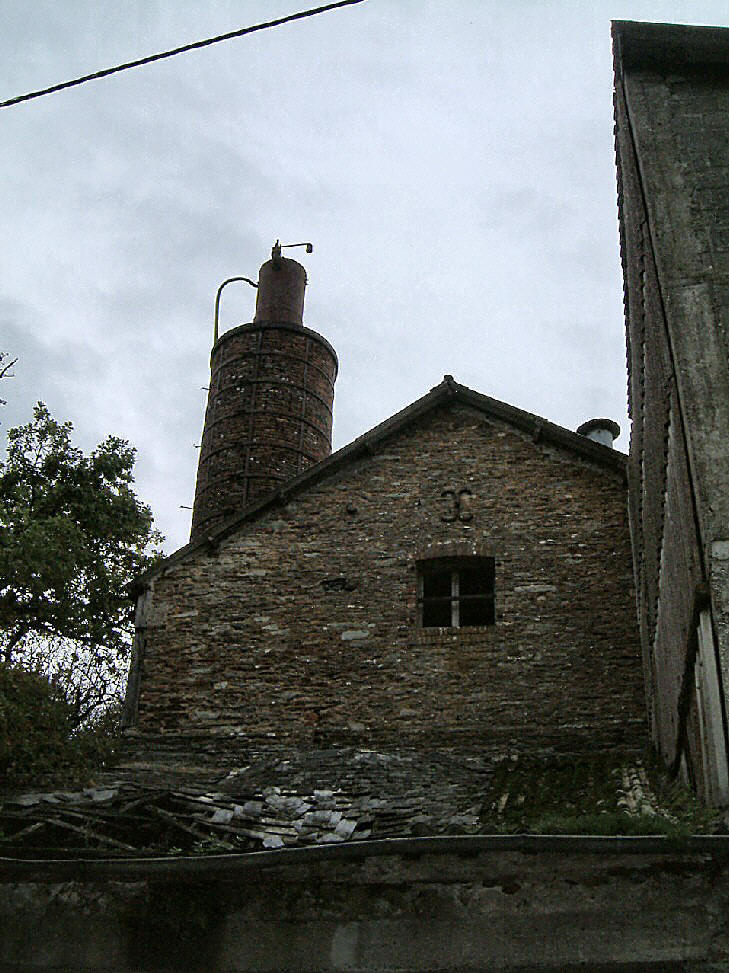
It is this chimney that can still be seen, rising above the hamlet's
rooftops, ringed in iron and strapped with a ladder. It is all that remains
standing of the works that supported the Chauvel for three generations, and
the last witness to the Pays de la Mée's metallurgical adventure.
One more detail belongs here, unrelated by blood but telling of how dense
these places were: the house next to the blast furnace is the one where the
ancestors of Sophie Trébuchet lived — the mother of Victor Hugo.
The blast furnace chimney, listed as a historic monument on 1 April 1986. chouannerie.chez-alice.fr
The flour mill and, behind it, the blast furnace chimney. chouannerie.chez-alice.frInside the flour mill: pulleys and drive belts, still in place beneath the floor. chouannerie.chez-alice.frThe clerk's house. He was the one who kept the forge's accounts, weighed the iron and paid the charcoal-burners — the go-between for the often-absent ironmaster and the workers. chouannerie.chez-alice.fr
IV · La Rigaudière
The inn, the forge and the workshop
A hamlet of Riaillé, and four members of the same kinship group
working there at the same time. Auguste Juvin and his wife Marie Rosalie Ouary ran
the hotel-restaurant there. Her brother, Olivier Ouary, was a blacksmith there.
Their son-in-law Joseph Muloise, who married their daughter Marguerite, was a
carpenter there. The drinks trade, the forge and the woodworking shop, all in the
same hamlet, in the hands of a single family, across two generations.
The detail is not incidental: it extends the previous
story exactly. The Chauvel had followed the iron all the way to Riaillé, where the
forge went cold in 1875. The trade itself did not die out — it retreated from the
blast furnace to the village anvil, and it was an Ouary who held it at la
Rigaudière a generation later.
Five generations behind a counter
Running an inn was never a trade on its own. It always
came second, backed by another occupation: one was a baker and innkeeper,
a blacksmith and tavern-keeper, a carpenter and café-keeper. In a
bocage market town, the drinks trade was the supplementary income, and the place
everyone passed through.
Jacques Guérinc. 1747 – 1794 · 7th generationbakerinnkeeper of L'Écu de France, Riaillé
Olivier Chauvel1799 – 1875 · 6th generationblacksmithinnkeeper and tavern-keeper, Sion-les-Mines then Riaillé
Anne Marie Morel1806 – ? · 6th generation—innkeeper, Sion-les-Mines
Auguste Juvin1855 – 1915 · 4th generation—café-keeper and hotelier, la Rigaudière
Marie Rosalie Ouary1855 – 1939 · 4th generation—hotel-restaurant at la Rigaudière
Joseph Muloise1891 – 1945 · 3rd generationcarpentercafé-keeper, la Rigaudière
René Blanchet1893 – 1964 · 3rd generationcarpentercafé-keeper, Teillé
This sheds light, in passing, on a detail from Part Two.
If Jacques Guérin was municipal officer in 1794, that was no accident of
temperament: he kept the town's inn. In a commune of a thousand inhabitants, the
innkeeper sees the news, the pedlars and the gendarmes go by. That is also what
makes him a target: the chouans knew where to find him.
What the declared occupation doesn't say
These occupations come from civil-registration records, where each person
declares themselves as they see fit. The same man could be a "laboureur" at his
marriage and an "innkeeper" at his third child's baptism, without having changed
his life: he simply mentioned the other half of what he did. The occupations
recorded here are therefore snapshots, not careers.
Then no one at all
Among the four hundred and twenty-six reconstructed
ancestors, there are twenty-two laboureurs, farmers, blacksmiths, carpenters,
masons, a wool carder, a miller, a handful of innkeepers — and exactly two
occupations that resemble no other, both at the first generation. A history
teacher and journalist; a natural-science teacher.
Four centuries of land, iron and the counter, and then the first generation to
teach. What sixteen generations had not shifted tips over in just one.
V · 1914-1918
Those who died, the one who wrote
Two men of this ancestry died at the front. Neither is a direct
ancestor, and that is no coincidence: a line is only passed on by those who came
back. They are two brothers of ancestors — the great-grandfather's, and the
great-great-grandmother's.
Henri Auguste Bonnet29 · 1915Quennevières, Oise
Jean Marie Joseph Jumois33 · 1916Tahure, Marne
Henri Bonnet and Louis Frédéric, the great-grandfather,
were brothers, born a year apart. Both went to war; one came back, married Marie
Bernardeau in 1924 and farmed a holding at Carquefou until 1957. The other fell at
twenty-nine at Quennevières, a farm name in the Oise that in June 1915 came to
designate an entire offensive. Eight months later, Jean Jumois died at Tahure, in
Champagne.
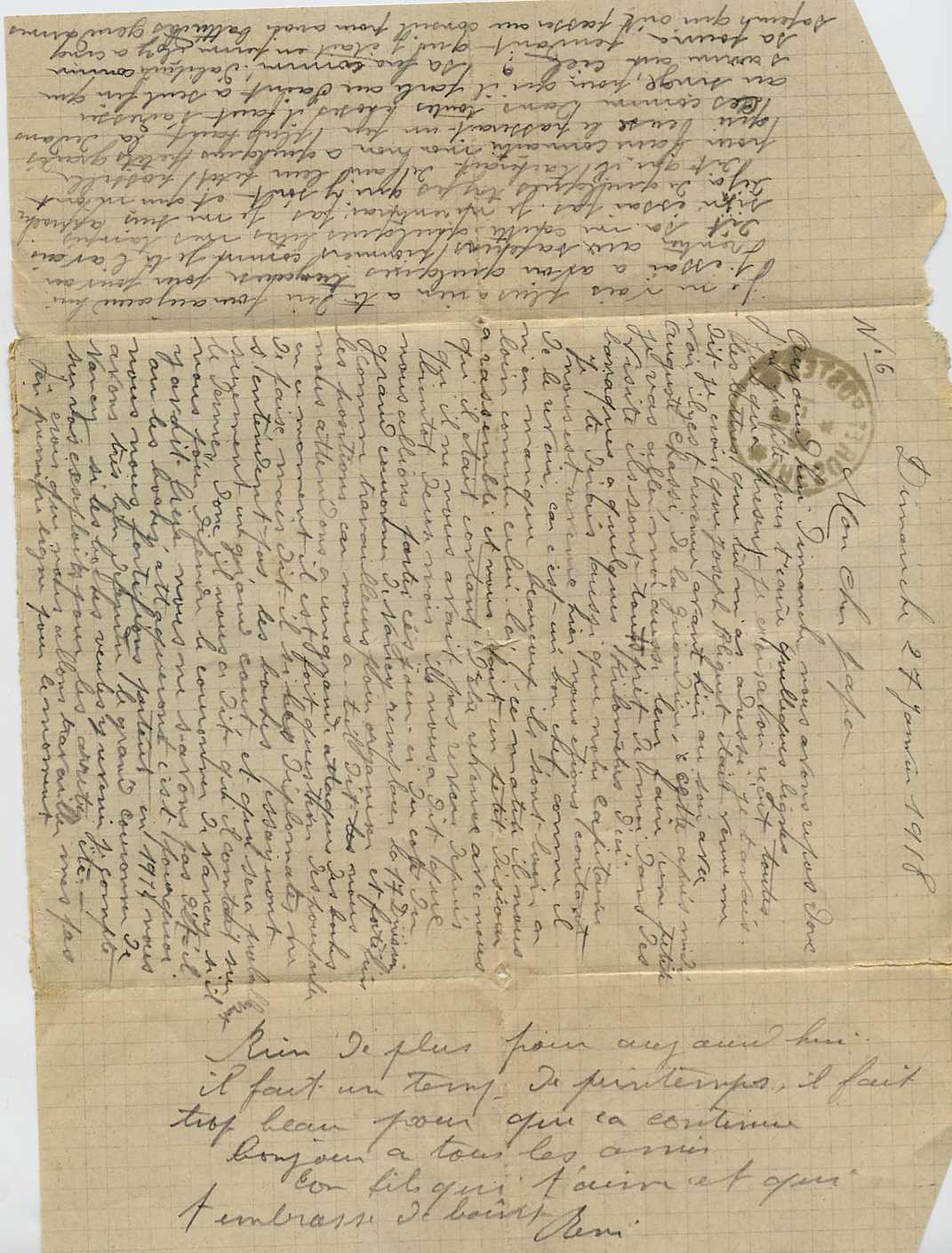
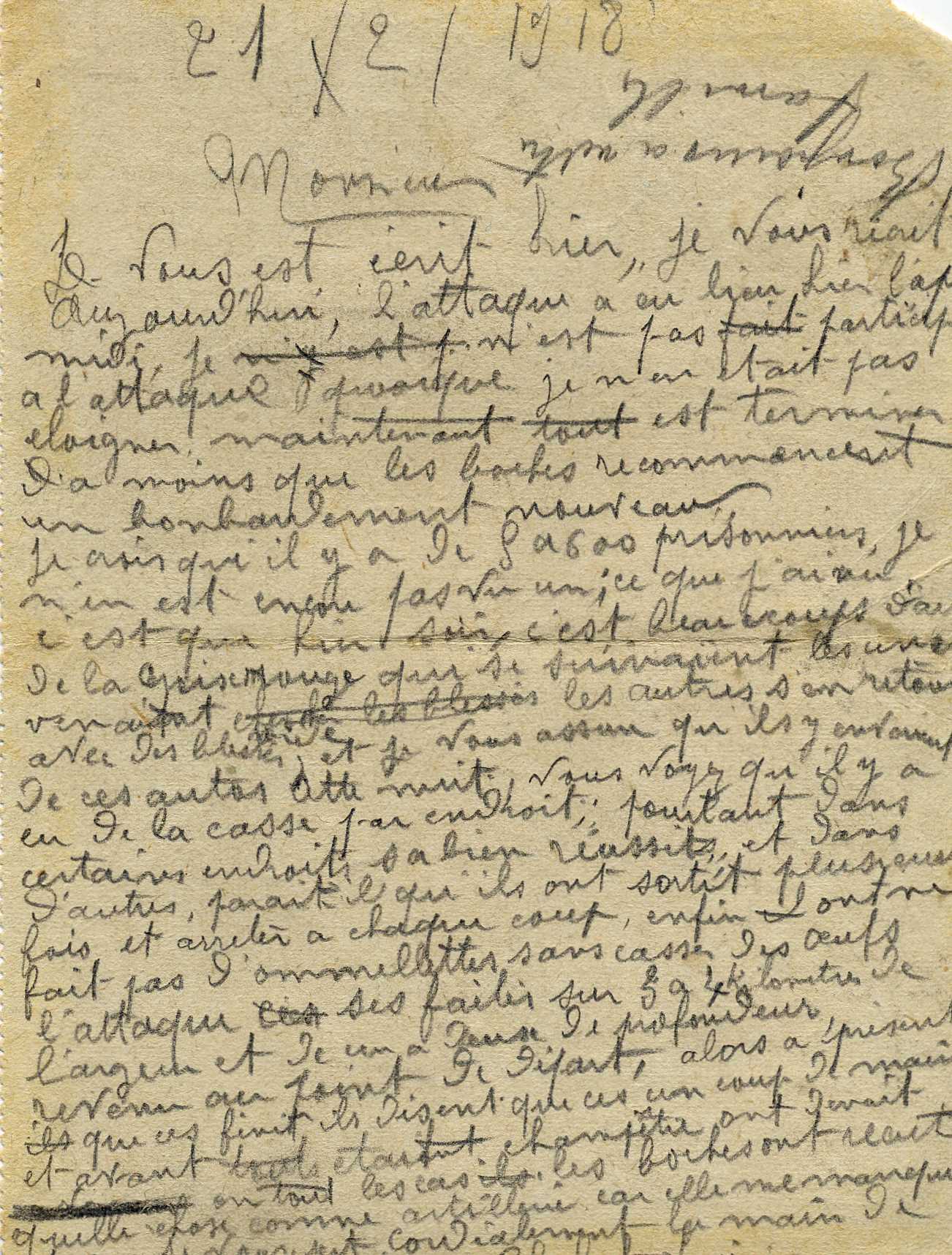
The letters of René Blanchet
Both great-grandfathers of this line went to war and
came back. Louis Frédéric Bonnet, a stretcher-bearer, on the paternal side. René
Joseph Blanchet, born at Teillé on 20 March 1893, on the maternal side — in the
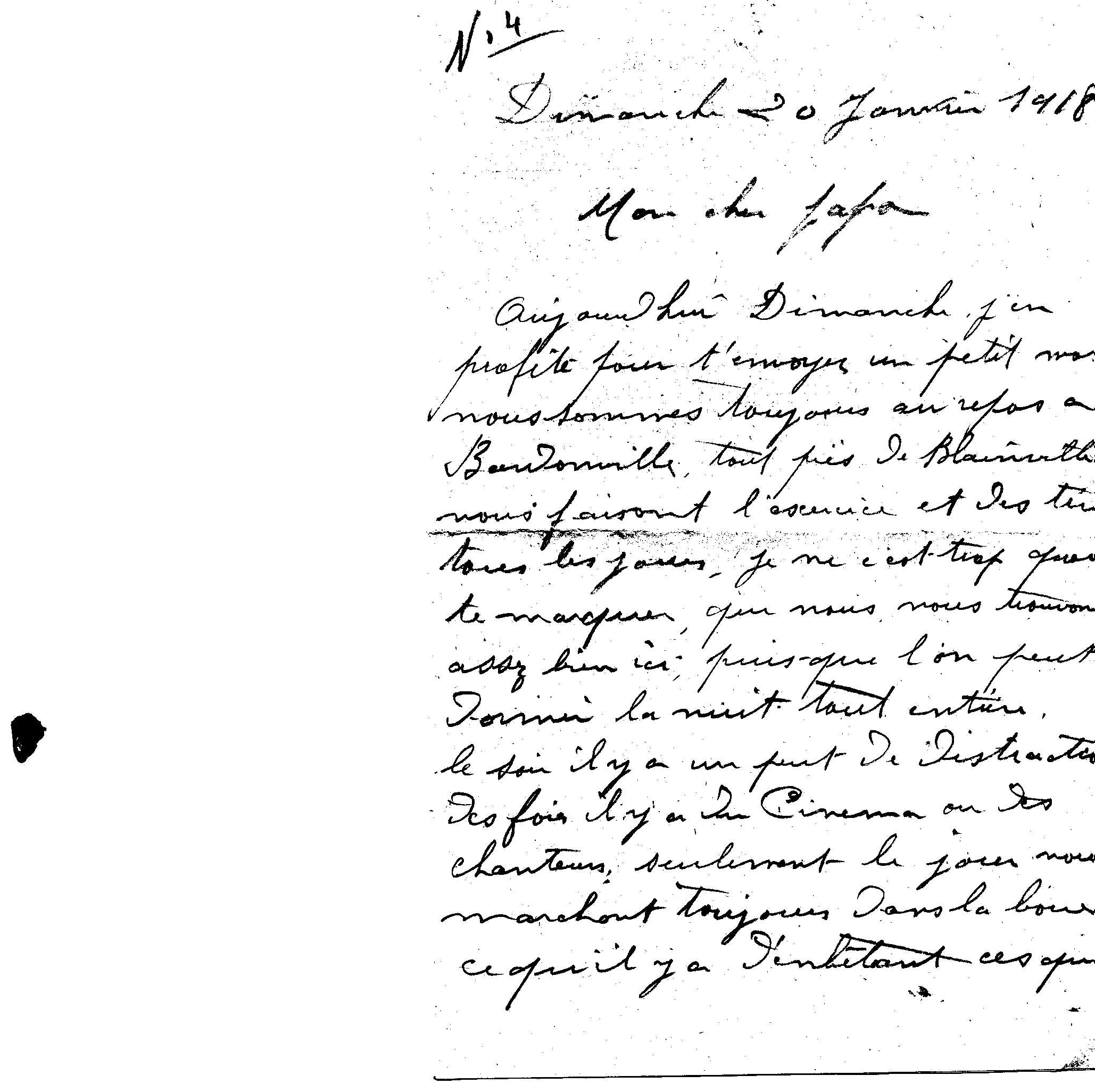
114th Infantry Regiment, 2nd Company, postal sector 166. Of
him, the family has kept letters, written almost every week to his father, a
carpenter at Teillé, and numbered so that none would be lost.
They do not tell of battles. They speak of the price of wine — thirty-six to
forty sous a litre, "far too expensive for soldiers" —, the cinema and
the singers of an evening at billets, the mud one walks through by day, and the
happiness of sleeping through a whole night. On 20 January 1918, the regiment is
resting near Blainville, in Meurthe-et-Moselle: it has just left the Forêt de
Parroy, where it had held a quiet sector for five months.
Sunday 20 January 1918, letter no. 4. "My dear papa." Family collectionSunday 27 January 1918, letter no. 6, with its postmark. Family collection21 February 1918: the account of an attack he did not take part in. Family collection
Then comes June 1918. The 114th had left Lorraine at Easter for
the Somme, and found itself engaged at Méry, in the Oise, facing the German
offensive. For three days — the 11th, 12th and 13th of June — the regiment
held; the 650 men it lost there, including twenty-four officers, would earn it
the Croix de guerre. Mangin would sum up the affair in a line about
"the unforgettable green of the wheat on 11 June, and the red, that of the
blood that stained it."
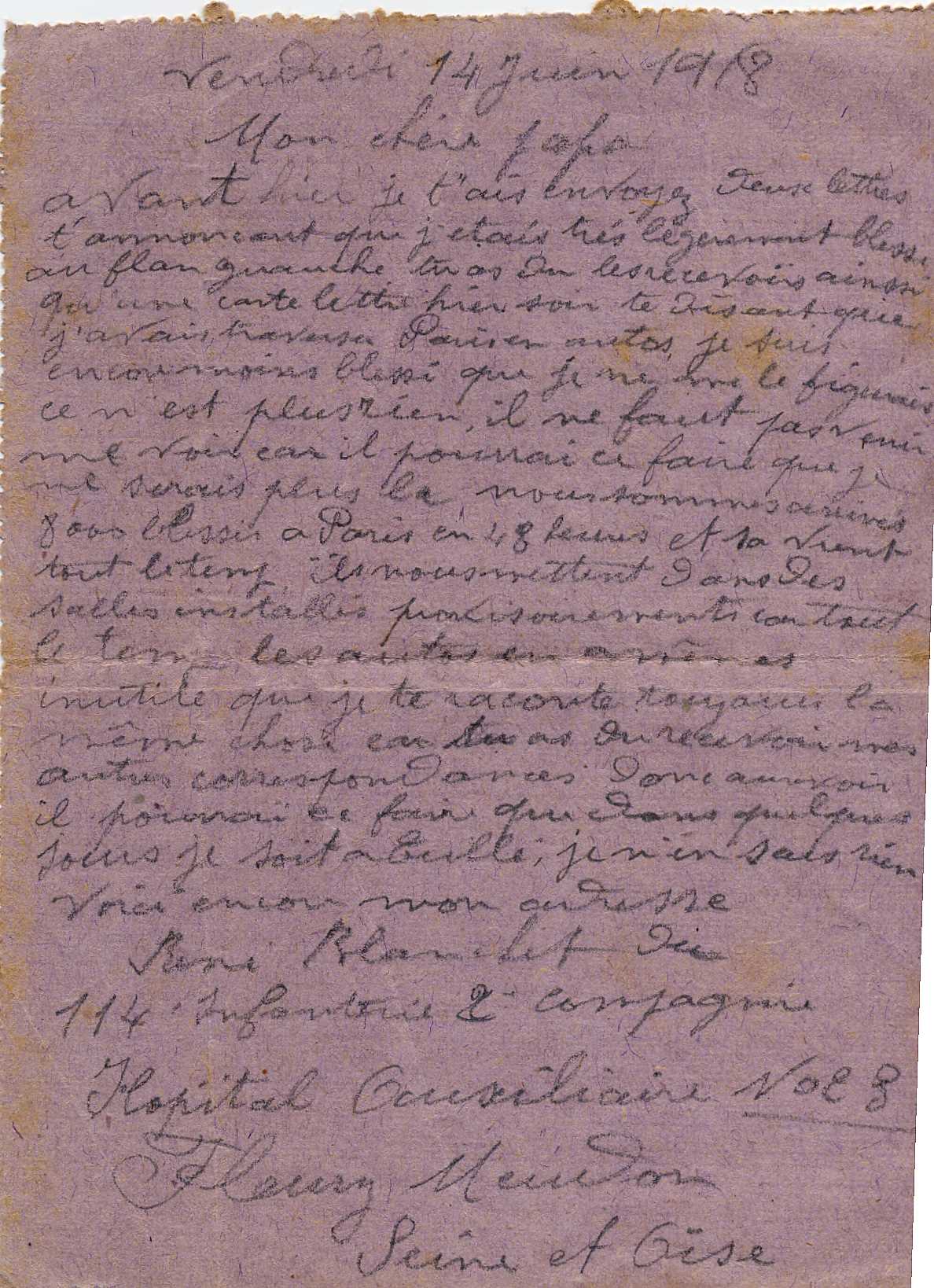
René Blanchet was one of them. Wounded in the left side on the 12th,
evacuated, he crossed Paris by car and wrote on Friday 14 June from Auxiliary
Hospital No. 3 at Fleury-Meudon. His letter is mostly concerned with
reassurance: the wound is less serious than he thought, it's nothing now, and
above all his father should not come — he might not be there any more.
One line, in passing, reveals the scale of what the family did not know:
eight hundred wounded arriving in Paris within forty-eight hours, in wards set
up in haste, and it went on like that the whole time.
Friday 14 June 1918, written from Auxiliary Hospital No. 3 at Fleury-Meudon, two days after he was wounded. Family collection
VI · The American cousin
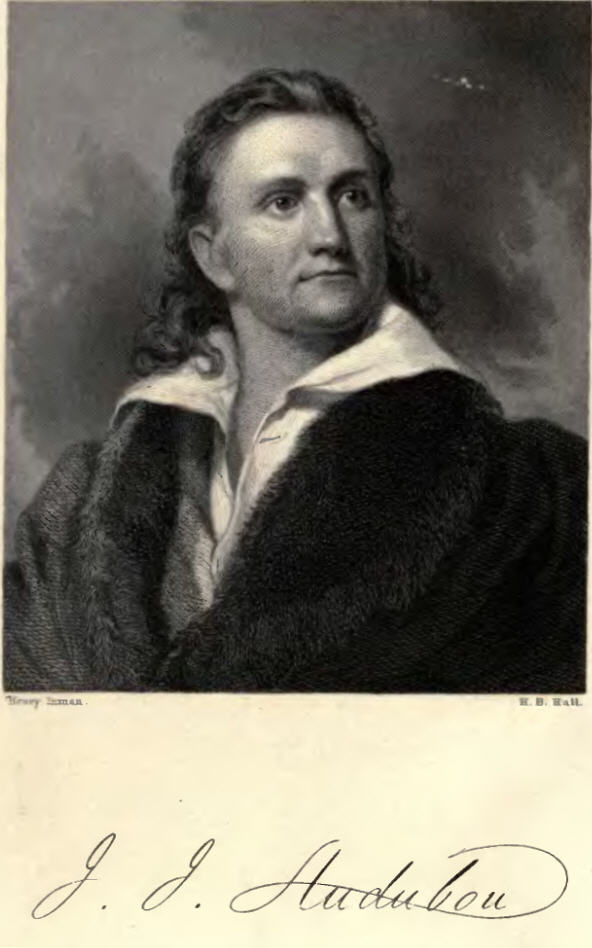
John James Audubon
The world's most famous painter of birds was born Jean Rabin, on
26 April 1785 at Les Cayes, in Saint-Domingue. His mother, Jeanne Rabine, had been
born twenty-seven years earlier in the hamlet of Les Mazures, commune of Les
Touches — in the very parish where the Ouary had been laboureurs for two
centuries. Both lines trace back to the same man.
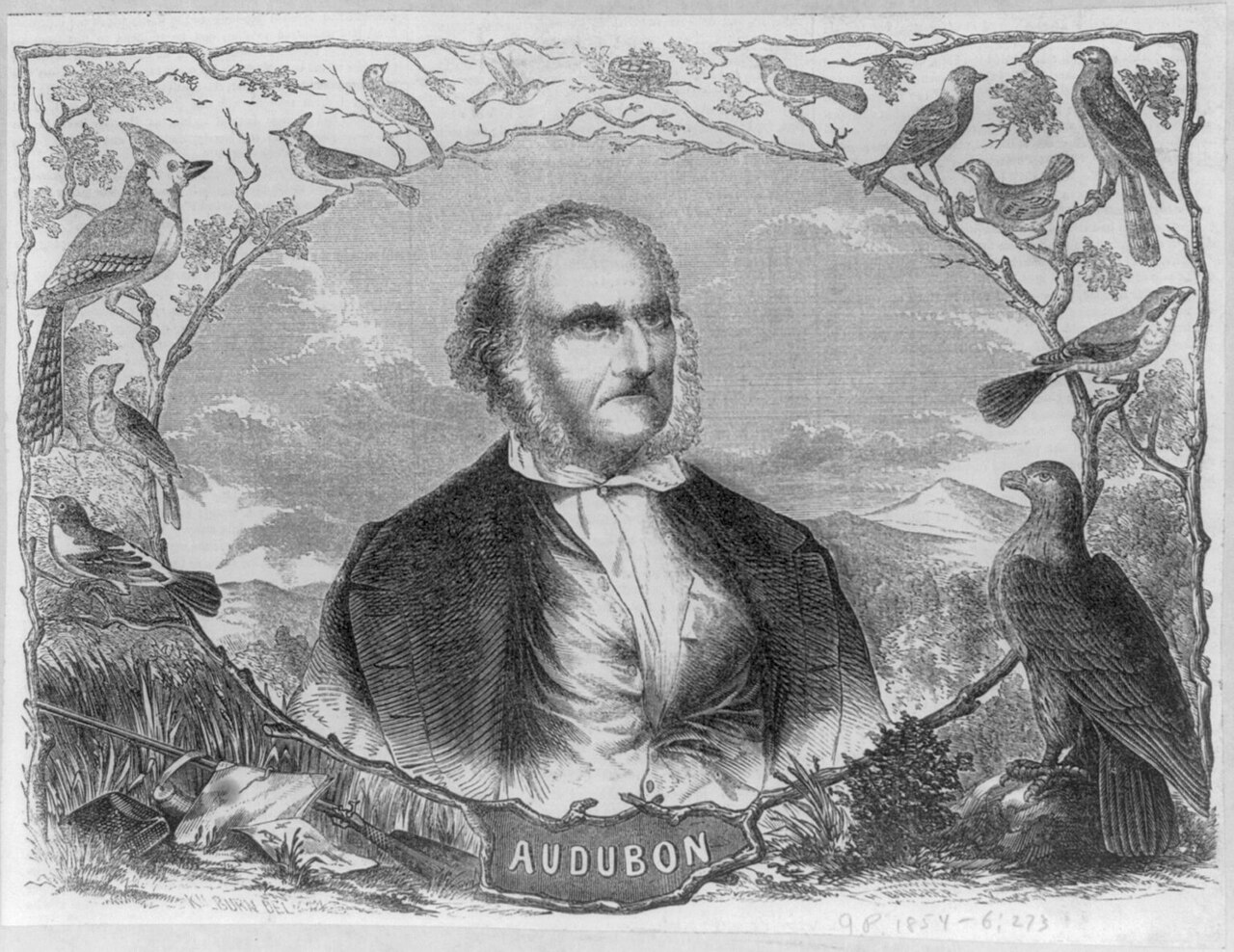
John James Audubon. The naturalist posed as a trapper to serve his American legend. Library of Congress, public domain · Wikimedia CommonsBorn Jean Rabin at Les Cayes, died John James Audubon in Manhattan: three names for one life. Wikimedia Commons, public domain · Wikimedia CommonsMemorial portrait, surrounded by vignettes drawn from his plates. Library of Congress, public domain · Wikimedia Commons
The two branches
Guillaume Ouary, a laboureur at Les Touches, died in
1652. Two of his children opened two unrelated stories: his son Pierre stayed in
the village, his daughter Renée was the origin of the line that would lead to
Audubon. Eleven generations on one side, seven on the other.
Sixth-degree cousinship, four generations apart.
Jeanne Rabine, lady's maid
Baptised at Les Touches, at the church of Sainte-Mélaine, on 14 March
1758. Cébron the tanner, a neighbour from the hamlet of Les Mazures,
recommended her to Jacques Pallon de la Bouverie, a retired judge turned
planter. She embarked at the Quai de la Fosse in Nantes aboard Le
Conquérant, with the Pallon family, for Saint-Domingue. She was a little
over twenty, and would never see Brittany again.
The date of this departure is not settled. The commune of Les Touches
gives 23 October 1781; Yvon Chatelain's biography, repeated by the
genealogical databases, states September 1783. Two years apart between two
secondhand sources, which no archival document consulted here can resolve.
The ships' muster rolls held at the Archives départementales de
Loire-Atlantique would settle it.
The ship itself cannot be traced. The name recurred often among Nantes
shipowners — a Conquérant of Nantes appears as early as 1746 among
the prizes seized by the English — and nothing allows Jeanne Rabine's ship to
be identified. One thing is certain, however: carrying a magistrate, his
wife, his three daughters and their servant, it sailed en droiture,
the direct route to the colony, rather than the triangular circuit of the
slave trade. A nuance that matters, since the man who took her in on arrival
was himself a slave-ship captain.
At Les Cayes, she met Jean Audubon, a Nantes sea captain, planter and
slave trader, married in France. She died a few months after her son's
birth, carried off by a tropical fever. The child was entrusted to Catherine
Bouffard, his father's companion, then brought back to France in 1788.
He grew up at La Gerbetière, in Couëron, with his father's lawful wife.
In 1794, the couple adopted him under the first name Fougère — the
name of the day of his birth in the French Republican calendar. In 1803,
equipped with a false passport meant to spare him conscription, he sailed
for the United States under the name John James Audubon.
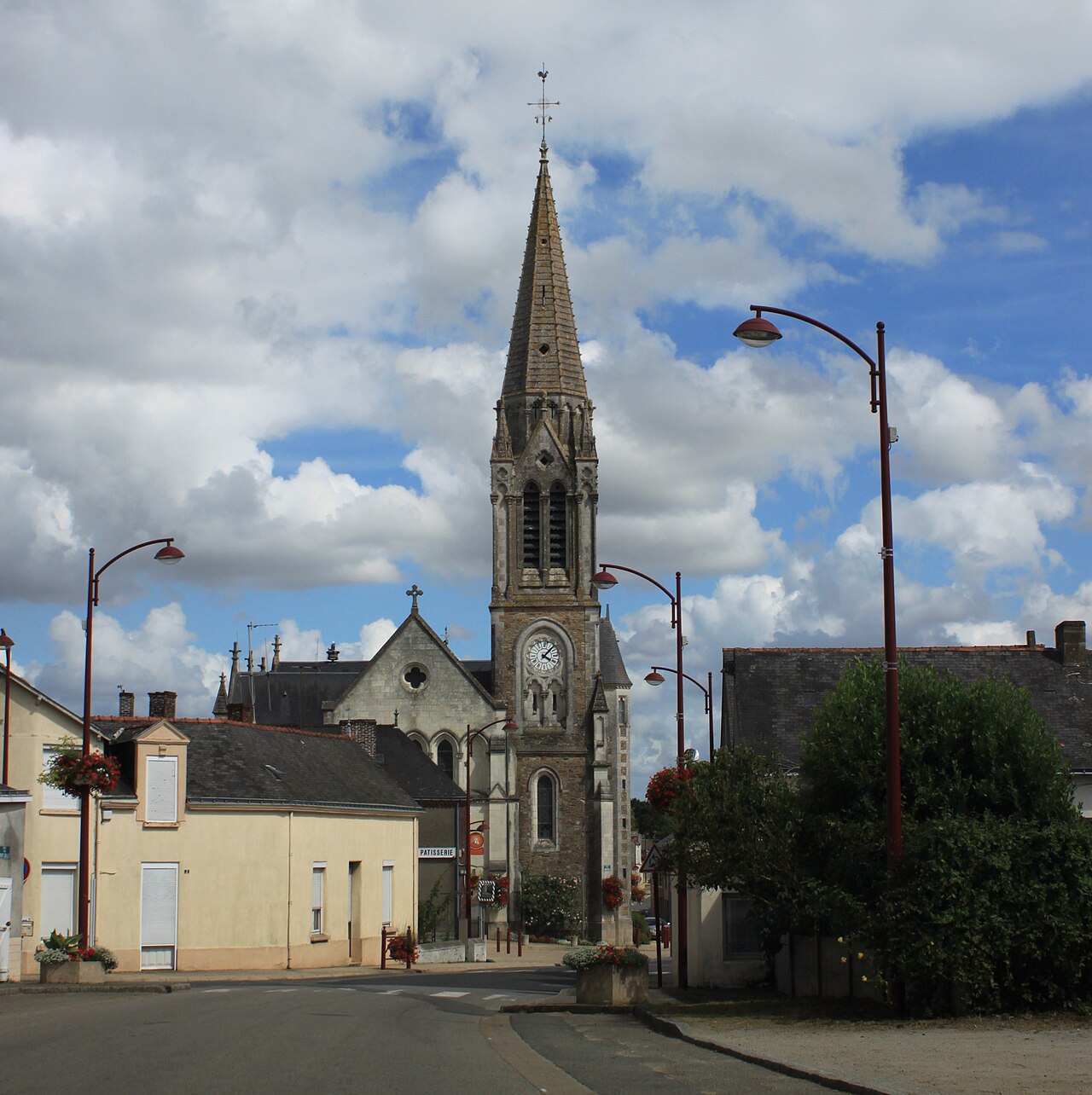
The Sainte-Mélaine church at Les Touches, the parish where Jeanne Rabine was baptised in 1758. Llann Wé², CC BY-SA 3.0 · Wikimedia Commons
A life
1785Born at Les Cayes, in Saint-Domingue, under the name Jean Rabin. His mother dies a few months later.
1788His father brings him to France. He grows up at La Gerbetière, in Couëron, with his father's lawful wife.
1794Adopted under the first name Fougère, the name of the day of his birth in the French Republican calendar.
1803Leaves for the United States with a false passport, meant to spare him Napoleonic conscription.
1808Marries Lucy Bakewell. The couple set off to try their luck on the Kentucky frontier.
1819Bankruptcy, debtors' prison. He has nothing left to live on but his pencil, and takes up portraiture.
1826Sails for England with 250 drawings, seeking engravers and subscribers.
1827First instalment of The Birds of America. Engraving begins in Edinburgh with Lizars, then moves to London with Havell.
1838Final plate. Eleven years of publication, 435 plates, 1,065 birds.
1851Dies in Manhattan, on the estate that will become the Audubon Park neighbourhood.
The work
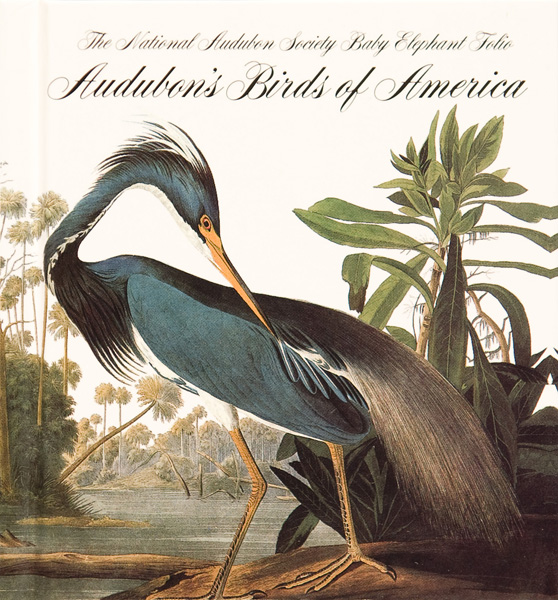
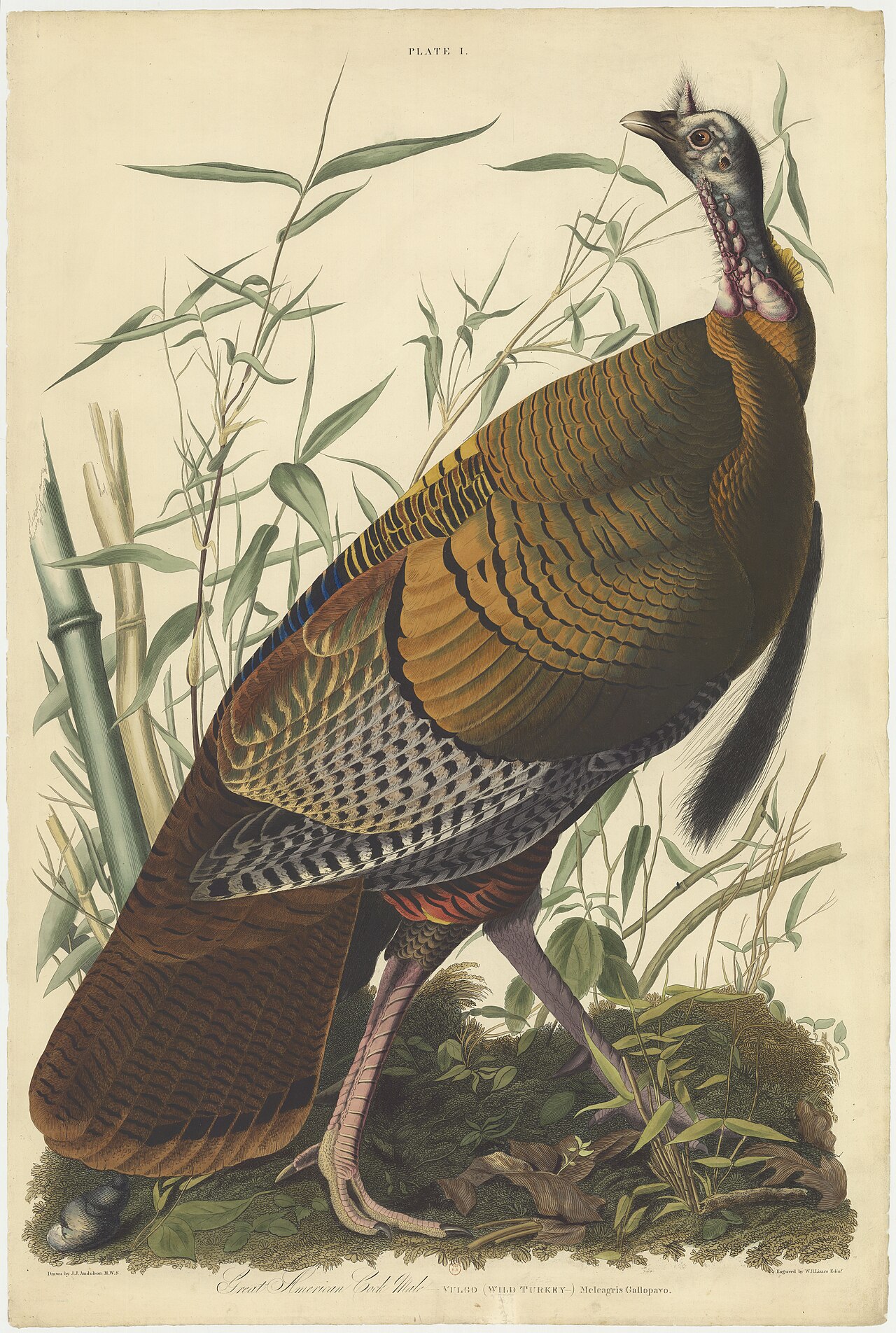
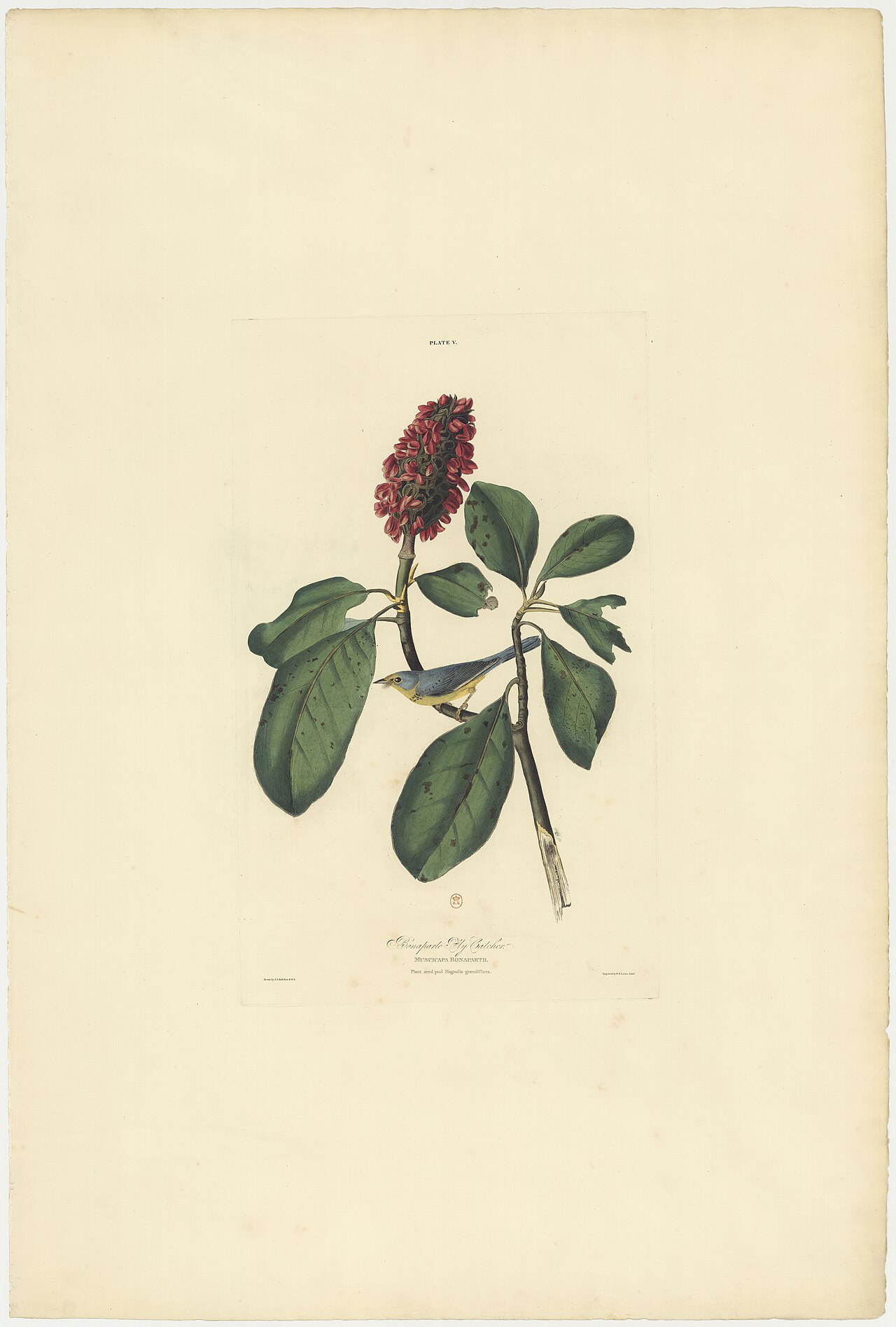
The Birds of America is as much a technical
folly as an artistic one. Audubon insisted that every bird be shown life-size:
this called for "double elephant" paper, the largest format available, and the
flamingo had to bend its neck to fit on the page. Every plate was etched and
aquatinted, then coloured by hand, one at a time.
435plates engraved, hand-coloured, published from 1827 to 1838
1,065birds depicted, all life-size
97 × 66centimetres: the "double elephant" format, dictated by the size of the heron
$11.5million, a world record for a printed book, Sotheby's 2010
The Birds of America, the work of a lifetime, published at his own expense over eleven years. Wikimedia Commons, public domain · Wikimedia CommonsPlate I: the wild turkey, engraved by W. H. Lizars in Edinburgh. Audubon made the "gobbler" his personal seal, with the motto America my country. BnF via Wikimedia Commons, public domain · Wikimedia CommonsPlate V, first instalment. Every bird is painted life-size, on its host plant. BnF via Wikimedia Commons, public domain · Wikimedia Commons
Funding came through subscription, plate after plate,
over eleven years. The undertaking cost Audubon $115,640 of the day's money —
more than two million today — which he financed by selling oil copies, portraits
and the skins of animals shot along the way. Fewer than a hundred and twenty
complete copies survive. In December 2010, one of them sold for $11.5 million at
Sotheby's in London: the highest price ever paid for a printed book.
The one who paid
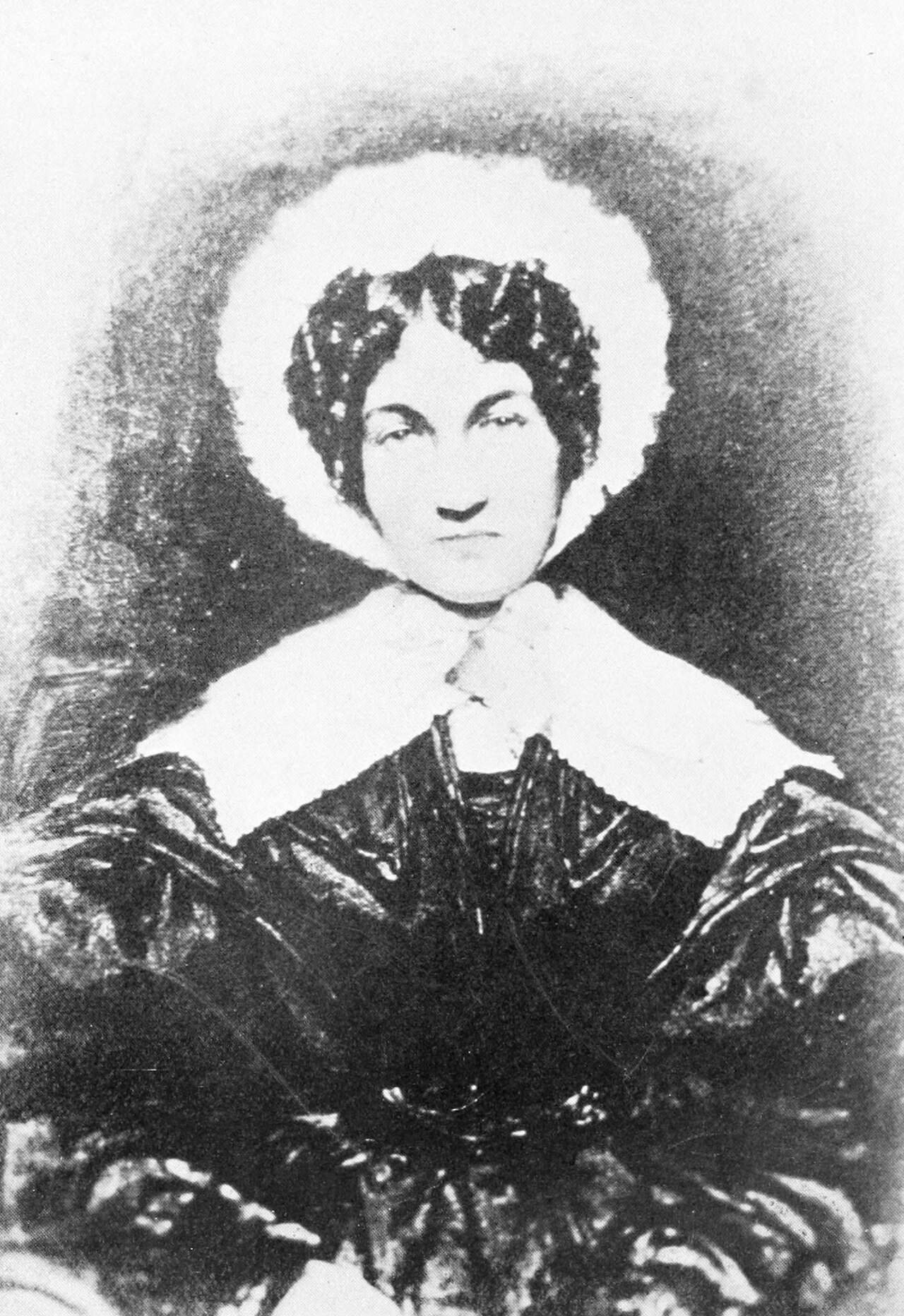
Someone earned those hundred and fifteen thousand dollars. Lucy Bakewell
was sixteen and Audubon eighteen when he landed in 1803 at Mill Grove, his
father's property, adjoining Fatland Ford where the Bakewells lived. They
were neighbours before they were husband and wife; they married on 5 April
1808.
After the 1819 bankruptcy, it was she who became the family's
breadwinner, to free her husband and let him devote himself to the birds.
She left for Louisiana in 1821 and taught, first for board and lodging, then
on her own account. From 1823 to 1830, she ran classes for young girls at
Beech Woods and then at Beech Grove — in that same parish of West Feliciana
where Audubon painted at Oakley, and where the bridge today bears his name.
She founded two schools at a time when women had practically no right to
earn a wage. She obtained an eight-thousand-dollar advance on her
inheritance from her father, and managed to save three thousand dollars to
send Audubon to publish his book in Europe. While he was away for months,
sometimes years, she raised their sons, ran the household's affairs, shipped
the skins and plants he asked for, kept the subscriptions and coordinated
the engravers' work.
Four children, of whom two daughters died in infancy — Lucy in 1817, Rosa
in 1820. She would outlive her husband and both her sons, and would die in
1874, aged eighty-seven, in Kentucky.
If I were jealous, I should have a bad time of it, for every bird is my rival.
Lucy Bakewell Audubon
Lucy Bakewell Audubon (1787-1874). Without her, not a single plate would have been engraved. Wikimedia Commons, public domain · Wikimedia Commons
Three anecdotes
The silver thread. In the spring of 1804, at Mill Grove
in Pennsylvania, Audubon tied a silver thread to the leg of five fledglings —
eastern phoebes — to find out whether birds return to nest where they were
born. He claimed to have found two of them again the following year. The
story earned him the title of America's first bird bander. It is disputed
today: a 40% return rate is twenty times higher than what modern
ornithologists observe, and a reconstruction of the dates shows he was not
in Pennsylvania in the spring of 1805.
The fish hoax. In 1818, the naturalist Constantine
Rafinesque stayed with him in Kentucky. One night, believing he was catching
a bat of a new species, he smashed his host's favourite violin. Audubon took
his revenge by describing to him entirely imaginary fish and mammals of the
Ohio, which Rafinesque seriously published as new species.
The eagle that never existed. His career took off with
the "Bird of Washington," a giant eagle he claimed to have observed and of
which he made a spectacular plate. No specimen has ever been found, no
independent observation ever confirmed it, and recent scholarship concludes
it was fabricated. The bird that made him famous probably never flew.
These three episodes take nothing away from the work. They are a
reminder that Audubon was also an entrepreneur in search of subscribers, in
a scientific world where discovering a species was worth a reputation.
What bears his name
A mountain in Colorado, first: the Mount Audubon,
4,032 metres, in the Indian Peaks of the Front Range, north-west of Boulder.
A Manhattan neighbourhood next, Audubon Park, built on the estate where he
ended his days. Several birds, finally — Audubon's warbler, Audubon's
oriole, Audubon's shearwater.
And above all the National Audubon Society, founded in
1905, more than half a century after his death and with no connection to
his family. It is today the oldest and largest bird protection organisation
in the United States.
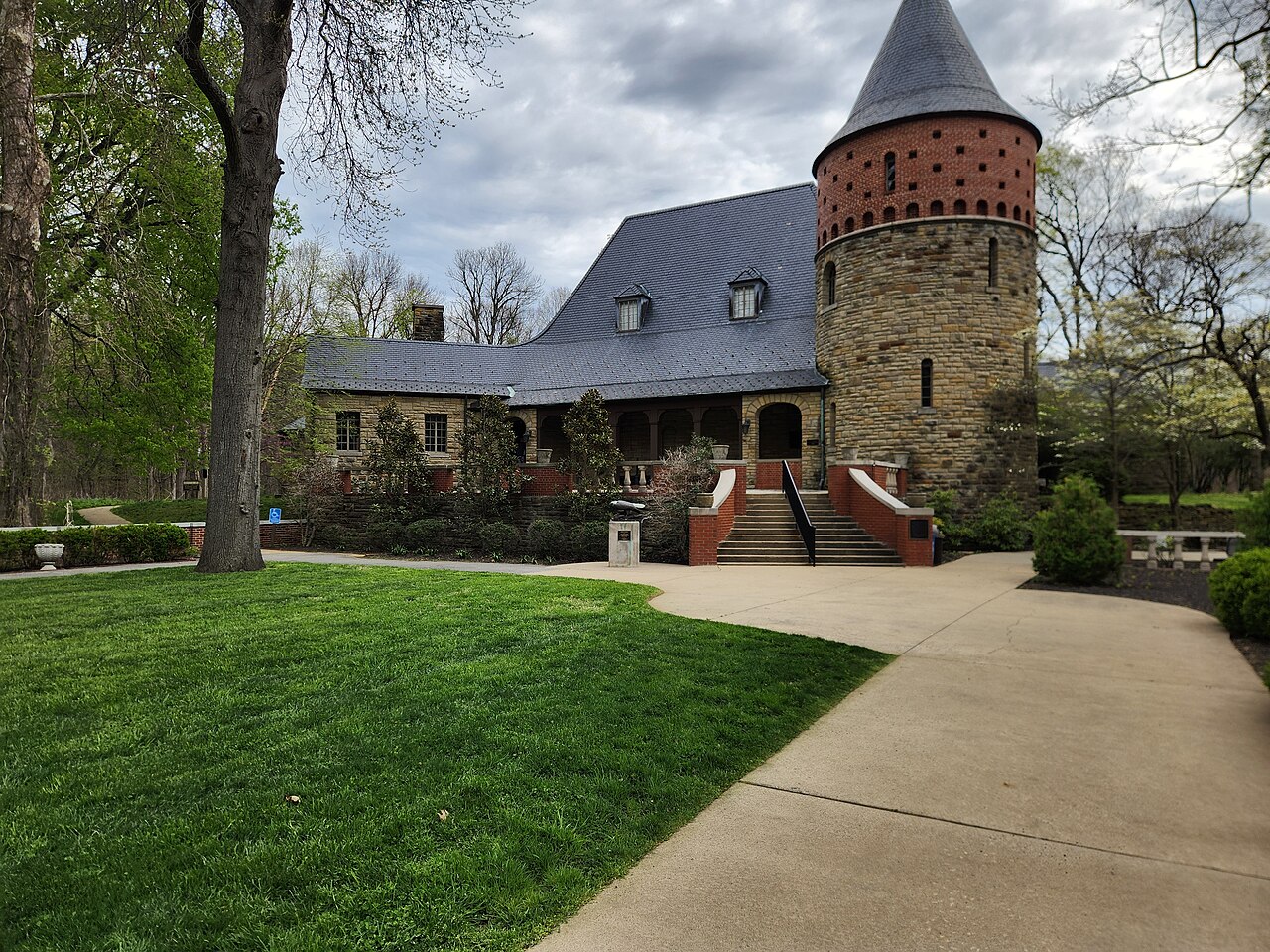
Two structures also bear his name, and say a good deal about what he
became over there. At Henderson, in Kentucky, where he kept a shop from
1810 to 1819, a museum built in 1938 houses one of the largest collections
of his originals — in a building in French Norman style raised in tribute
to his origins, whose tower has niches cut specially for birds to nest in.
And on the Mississippi, between the parishes of Pointe Coupee and West
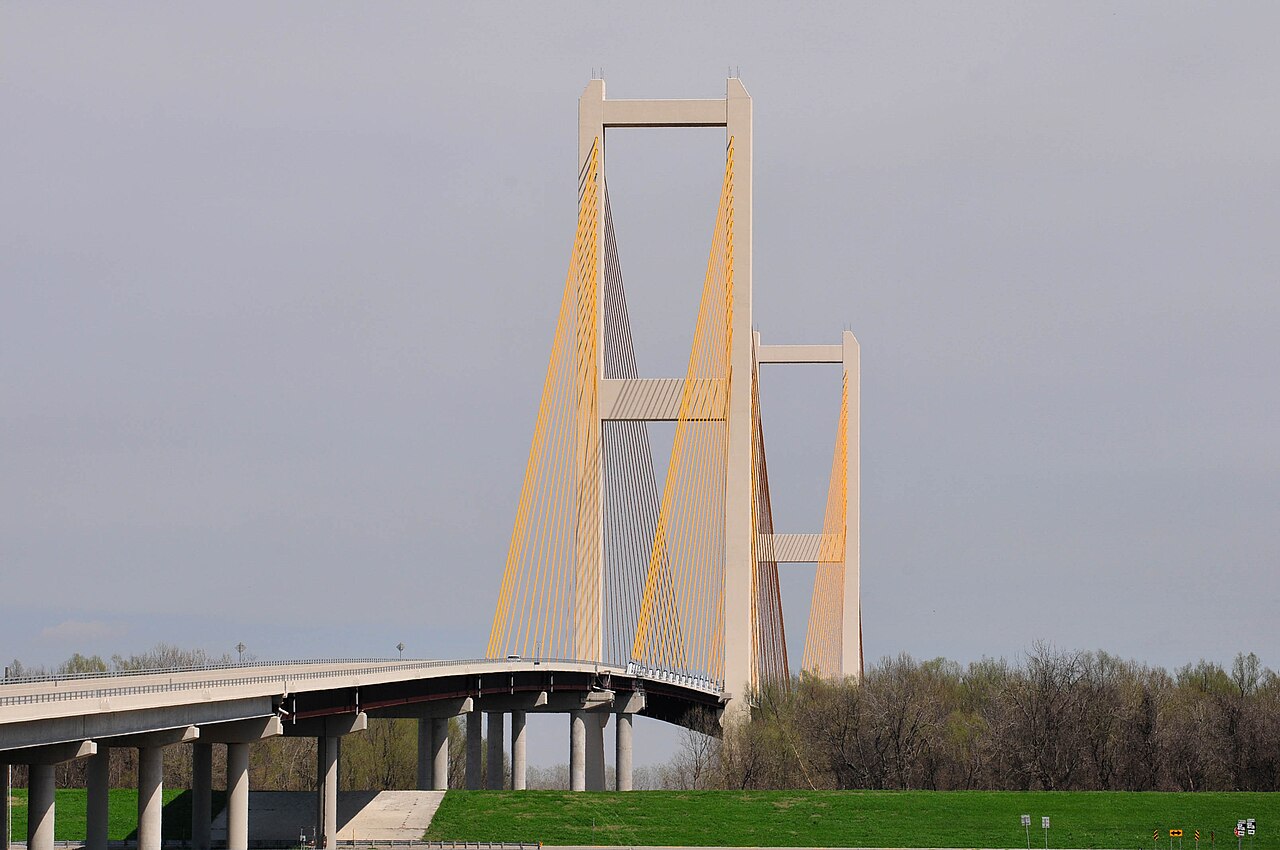
Feliciana, the John James Audubon Bridge, opened in May
2011. Its 482-metre main span made it, on opening, the longest cable-stayed
bridge in the Western Hemisphere. It replaces a ferry and remains the only
river crossing for a hundred and fifty kilometres. It spans the river a few
miles from Oakley Plantation, where Audubon painted some of his birds in
1821.
This name is contested. Audubon owned slaves — nine people worked in his
household — sold them at his bankruptcy, bought more in the 1820s, and
publicly opposed abolition. On 15 March 2023, after more than a year of
consultation, the National Audubon Society's board of directors voted to
keep the name, judging that the organisation "is bigger than the name of
one person," while committing $25 million to its diversity programmes.
The museum at Henderson, Kentucky, built in 1938 in a French Norman style in tribute to his origins. Its tower is pierced with niches where birds can nest. Wikimedia Commons · Wikimedia CommonsThe John James Audubon Bridge, opened in 2011: a 482-metre main span, the longest cable-stayed bridge in the Western Hemisphere on opening. Wikimedia Commons · Wikimedia Commons
His descendants
His two surviving sons, Victor Gifford and John
Woodhouse, married the two daughters of John Bachman, the naturalist-pastor of
Charleston who collaborated on The Viviparous Quadrupeds of North
America: Maria Rebecca and Mary Eliza, both of whom died before thirty, a
year apart. Both brothers remarried.
The American male line then very nearly died out. According to the biographer
Francis Hobart Herrick, William Bakewell Audubon (1847-1932), the painter's
grandson, emigrated to Australia; his son Leonard Benjamin, born in 1888,
remained the sole male representative of the American branch of the Audubons.
VII · The land today
Les Touches
Two thousand six hundred and thirty-eight inhabitants in 2023,
canton of Nort-sur-Erdre. The hamlet of Les Mazures still exists. The church of
Sainte-Mélaine, where Jeanne Rabine was baptised in 1758, was rebuilt in the
nineteenth century, but the commune keeps alive the memory of the woman who left
it.
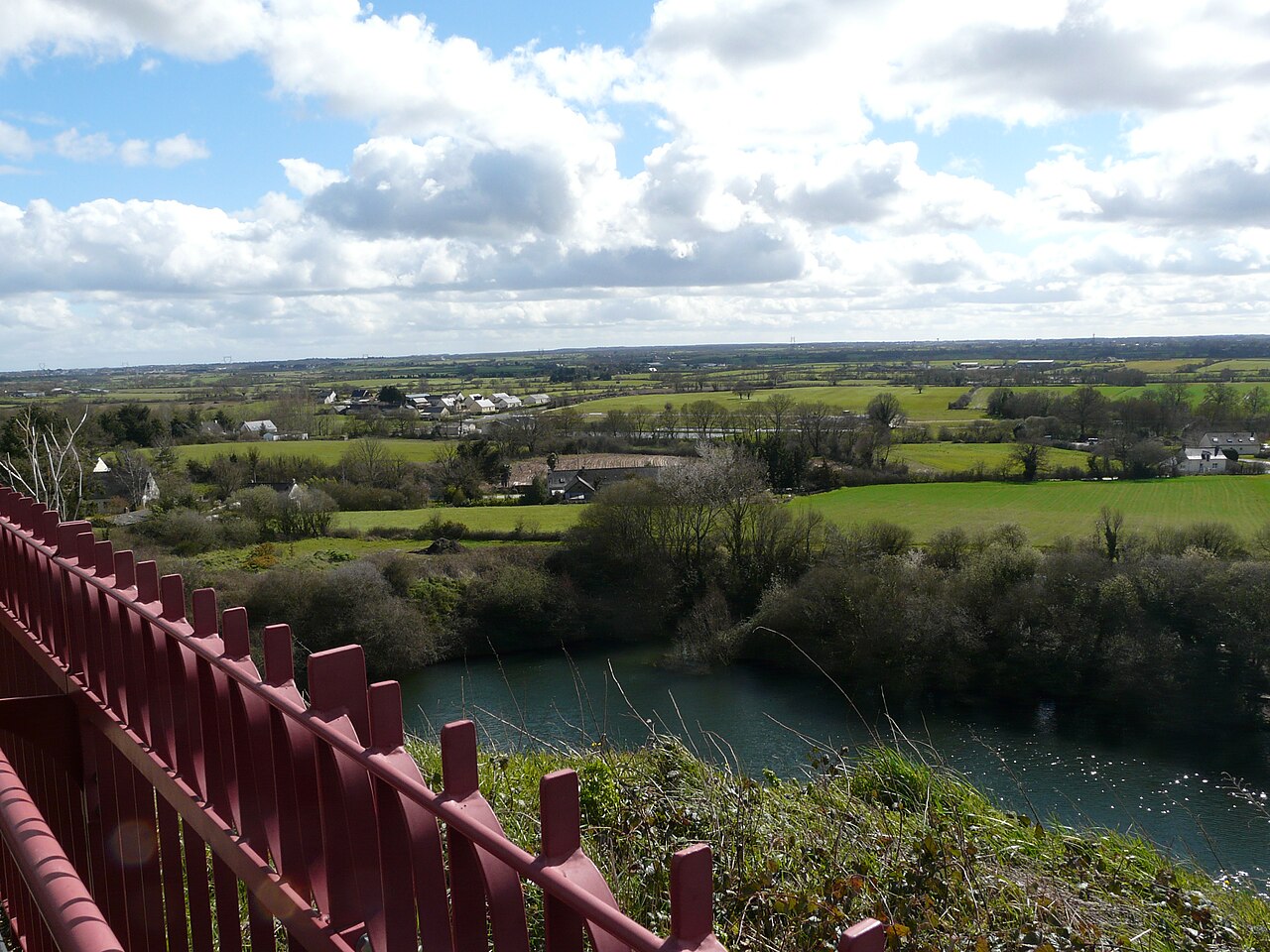
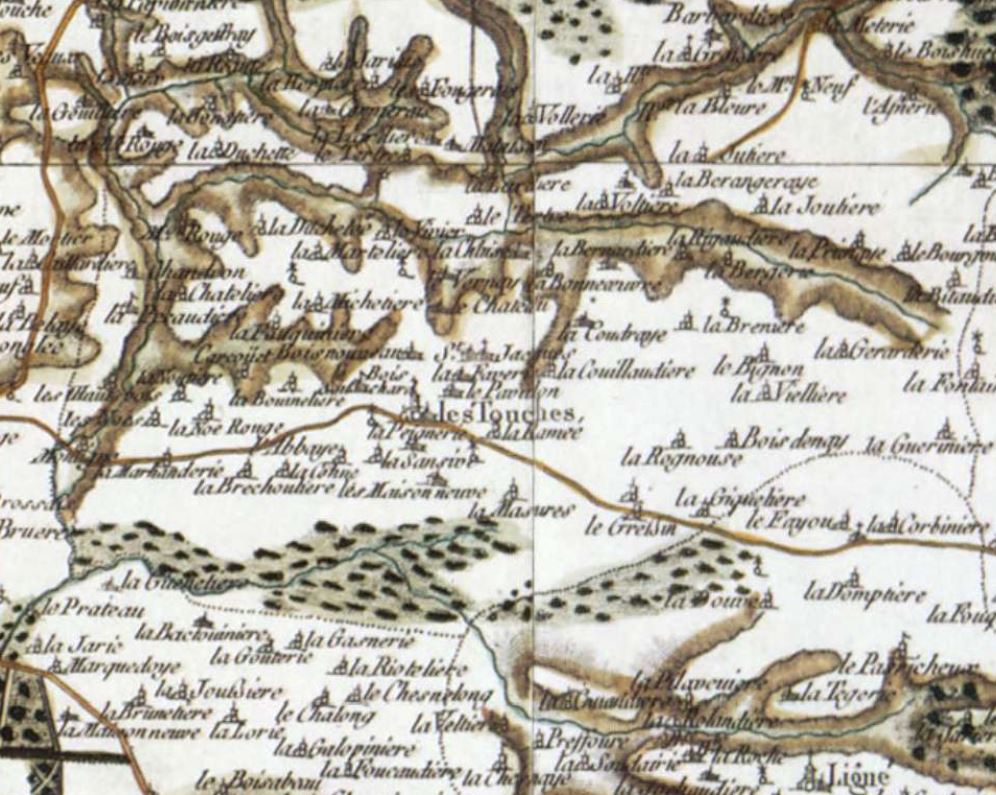
The bocage seen from Mont-Juillet: the landscape of nine generations out of sixteen. Wikimedia Commons · Wikimedia CommonsLes Touches on the Cassini map, surveyed shortly before Jeanne Rabine's departure. Wikimedia Commons, public domain · Wikimedia CommonsThe Sainte-Mélaine church, rebuilt in the nineteenth century. Llann Wé², CC BY-SA 3.0 · Wikimedia Commons
VIII · The tree
Four hundred and twenty-six people, arranged in circles
Each ring is a generation, each sector an ancestor. Green marks
an identified person, beige an empty slot. Names appear only on the first four
rings: beyond that, they would become illegible, but the drawing continues to
tell the essential story.
IX · What memory retains
The scale of generations
Each generation doubles the theoretical number of ancestors: 2
parents, 4 grandparents, 8 great-grandparents. By the sixteenth, it would take
65,536. The chart sets what theory demands against what the registers have
actually delivered. That collapse is the very subject of genealogy itself.
Up to the fourth generation, memory holds: fourteen
great-great-grandparents out of sixteen. Then the parish registers take over and
the yield collapses — 27% at the seventh generation, 3% at the eleventh. The
absolute maximum is reached at the eleventh generation, with fifty-nine
identified ancestors: that is the practical limit of the Loire-Atlantique
registers, the oldest of which go back to the mid-sixteenth century.
X · Living and dying
A life expectancy that declines before it leaps
Average age at death, calculated on the 1,158 people in the
tree for whom both birth and death are known, grouped by half-century of birth.
The curve declines steadily from the seventeenth
century to the early nineteenth, with a marked dip for the generation born
between 1800 and 1849 — the one that reached adulthood in an impoverished
countryside and faced the cholera epidemics. The twentieth-century recovery is
spectacular: more than twenty-six years gained in a century.
A caveat on the first point
The 61 years shown for the 1550-1599 cohort are a statistical mirage. For
that period, only people who lived long — and so left several records — could
be identified. Infants who died without a recorded baptism appear nowhere.
The figure measures the survival of documents, not of people.
Eleven per cent of the dated individuals die
before the age of five. The real figure was far higher: those are
precisely the children the registers forget most.
XI · The two branches
The two halves of the tree
The 426 ancestors on this page split exactly into two lines of
descent: 58 on the paternal side, 368 on the maternal side. Each is the subject
of a separate study, more detailed than what precedes it.
A beatified priest massacred at the Carmes in 1792, a
cavalryman dead at nineteen in Strasbourg, a brother killed on the first day of
Quennevières, a sister sent to Seoul in 1924.
Six generations of blacksmiths from Paimpont to
Riaillé, the massacre of 19 Prairial Year II, and the path to Audubon traced
generation by generation.
These two studies
revisit, in greater depth, episodes already mentioned above — Jacques Guérin, the
Forges des Salles, la Rigaudière, Audubon — and add others. The degree of cousinage
with Audubon is counted there from the previous generation: what is "four
generations removed" here becomes "three" there.
XII · The sources
The file, and a filmed archive
Everything above comes from a genealogical database that
anyone can take up, verify and correct. It is made available in GEDCOM format,
the standard exchange format in genealogy, readable by every piece of software
in the field.
Download the GEDCOM file
— 2,169 individuals, 668 families, 1.8 MB.
Version with living persons redacted.
This version has been corrected and deduplicated: broken encoding
fixed, dates normalised, commune names harmonised, eighty-two duplicate
records merged. People born less than a hundred years ago whose death is
not established appear here under the name "Living," with no date or place
— a publication convention that protects the living while preserving the
structure of the tree. Links to family photographs have been removed.
Any remaining errors are
flagged as such in the pages above. Any correction backed by a record is
welcome.
Database of 2,169 individuals and 668 families, from a MyHeritage export, corrected and deduplicated
Cross-checked against an independent 2020 GeneWeb database, which arrives at the same common ancestor by a different path
Every figure cited comes from a direct count on the file and remains recalculable
People born less than a hundred years ago whose death is not established are not named
Sources
Archives départementales de Loire-Atlantique, parish registers of Les Touches, Mésanger, Riaillé, Ligné
Commune of Les Touches, note "Jean-Jacques Audubon, naturaliste"
F. H. Herrick, Audubon the Naturalist, 1917
Y. Chatelain, Audubon, peintre, naturaliste, aventurier, 2001
M. J. Halley, "Audubon's famous banding experiment: fact or fiction?", Archives of Natural History, 2018
National Audubon Society, open letter of 16 March 2023
Illustrations
Plates from The Birds of America and portraits: public domain, via Wikimedia Commons and the Library of Congress
Views of Les Touches: Wikimedia Commons
Charts and maps: produced for this report from the genealogical data
Investigation compiled in August 2026. The older filiations rest on
transcriptions of parish records and remain, like any genealogy,
susceptible to correction by a return to the registers.